NEW YORK: A multi-billion-dollar robot dispatched to Mars to search for life must steer clear of promising “hot spots” for fear of spreading microbes from Earth, NASA project scientists said Thursday.
The spectre of a missed opportunity was thrown into sharp relief by smoking-gun evidence unveiled this week that liquid water, a prerequisite for life, existed not only in a distant Martian past, but is likely there today.
“Curiosity isn’t designed to go to a place that can currently support microbial life,” said Michael Meyer, a scientist for NASA’s Mars Exploration Program.
“For that we need a higher level of cleanliness,” which is more complicated and costly to achieve, he told AFP.
This exasperating reality was the result of a fateful decision years ago to forego NASA’s most stringent microbe-removal standards for hardware visiting the moist environments in which Martian life—if it exists—will probably be found.
The danger of letting Curiosity investigate the newly-found sites is real, space scientists and astrobiologists agree.
“We don’t want to be remembered as the species that went to another planet and wiped out whatever life was there,” explained Jorge Vago, a scientist with the European Space Agency’s (ESA) ExoMars Project, due to send it own Mars orbiter up in 2016 and put down a rover in 2018.
Scientists announced Monday they had found tracks formed by hydrated salt crystals—essentially super-salty brine—running down steep slopes on the surface of the Red Planet.
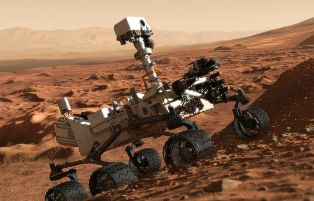
NASA’s Curiosity rover, a car-sized mobile laboratory parachuted into the Red Planet’s Gale Crater in August 2012, is especially well-equipped for microbe-hunting in just such an environment.Its core mission is to gather soil and rock samples and analyse them “for organic compounds and environmental conditions that could have supported life now or in the past,” according to NASA.
But the streaks, dubbed “recurring slope lineae” (RSL)—possibly the best chance yet of finding Martian life—are off limits for one simple reason: Curiosity is too dirty.