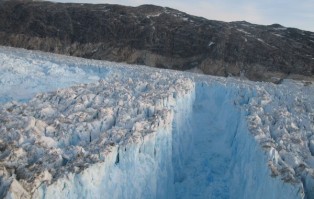


EUROPE: When large chunks of ice break off of a glacier and plop with a giant splash into the chilly water, the result can be lots of thunderous shaking. These mysterious glacial quakes have increased seven-fold in Greenland in the past two decades, according tonew research.
Now, scientists think they’ve figured out the cause of the rumbling phenomenon, at least in Greenland.
Scientists monitored the Helheim Glacier, a major outlet of the Greenland Ice Sheet, over 55 days from July to September 2013. They recorded 10 glacial earthquakes, some of which registered a magnitude of 5.0, and saw the glacier retreat by about 1 mile (1.5 kilometers) following the shaking events.
The scientists discovered that, when a big chunk of ice splits, or “calves,” from a massive glacier and tips forward into the ocean, it could force the glacier not only to stop inching forward, but also to push it backward. The backward movement and the subsequent change in water pressure cause glacial earthquakes, which can trigger massive tsunami waves and thunderous rumbling.
“It’s like taking a really strong spring, pushing on the front of it and just making it compress,” said study co-author Meredith Nettles, a professor of earth science at Columbia University’s Lamont-Doherty Earth Observatory in New York City. The glacier moves backward for a few minutes before springing forward again and moving as normal, Nettles said.
Glaciers typically move about 95 to 100 feet (about 30 meters) per day (or about 0.35 millimeters per second), but when an iceberg calves off and causes an earthquake, the force can turn the glacier completely around and force the front edge to move in the opposite direction at a rate of 130 feet (40 meters) per day — about 0.46 mm per second — for a few minutes, Nettles said.

Karachi Port sets 138-year cargo handling record
KARACHI: Pakistan's maritime sector has achieved a major milestone as Karachi Port set a new record in its 138-year history...