Customs Today
  • Home
  • Islamabad
  • Karachi
  • Lahore
  • National
  • Transfers and Postings
  • Chambers & Associations
  • Business
No Result
View All Result
Customs Today
  • Home
  • Islamabad
  • Karachi
  • Lahore
  • National
  • Transfers and Postings
  • Chambers & Associations
  • Business
No Result
View All Result
Customs Today
No Result
View All Result
Home Science & Technology Science

Mysterious radio signals detected from 5.5 billion light years away

byCustoms Today Report
19/01/2015
in Science, Science & Technology
Share on FacebookShare on Twitter

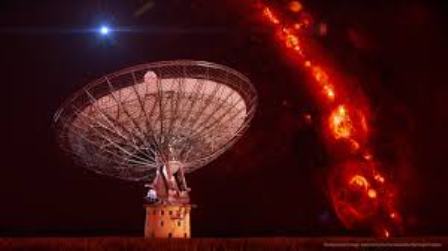
LONDON: Mysterious radio signals coming from an unknown source 5.5 billion light years away have been observed live for the first time. The fast radio bursts last just a few milliseconds, and just seven of these bright flashes have been discovered before – the first was found in 2007. All were found retroactively by looking through old data from the Parkes radio telescope in eastern Australia and the Arecibo telescope in Puerto Rico.

However, an international team of astronomers, led by Emily Petroff from the Swinburne University of Technology, have seen a radio burst in real time.


You might also like

Tesla driverless system to use updated radar technology

12/09/2016

Apple to develop its own self-driving technology

10/09/2016

John Mulchaey, acting director of the Carnegie Observatories, said: “These events are one of the biggest mysteries in the Universe. Until now, astronomers were not able to catch one of these events in the act.”

Petroff added: “These bursts were generally discovered weeks or months or even more than a decade after they happened! We’re the first to catch one in real time.”

Published in the Monthly Notices of the Royal Astronomical Society, the scientists mobilised 12 telescopes around the world and in space to capture the burst. After working out the burst location with the Parkes telescope, the others were used to make follow up observations on different wavelengths.

Daniele Malesani, astrophysicist at the University of Copenhagen, said: “Using the Swift space telescope we can observe light in the X-ray region and we saw two X-ray sources at that position. Then the two X-ray sources were observed using the Nordic Optical Telescope on La Palma.”

Findings showed the source of the burst was located up to 5.5 billion light years from Earth.

However, the source of the radio bursts remain a mystery, the authors said. “We found out what it wasn’t. The burst could have hurled out as much energy in a few milliseconds as the Sun does in an entire day,” Malesani explained.


Tags: Australia and the Arecibo telescope in Puerto RicoCarnegie ObservatoriesJohn MulchaeyMonthly Notices of the Royal Astronomical SocietyMysterious radio signalsParkes radio telescoperadio signals detected from 5.5 Billion light years awaySwinburne University of Technology

Related Stories

Tesla driverless system to use updated radar technology

byCT Report
12/09/2016

WASHINGTON: Electric carmaker Tesla announced Sunday it was upgrading its Autopilot software to use more advanced radar technology. In a...

Apple to develop its own self-driving technology

byCT Report
10/09/2016

SAN FRANCISCO: Apple may not become an automaker, but it still wants to develop its own self-driving technology. The iPhone-maker's...

NASA spots slowest known magnetar

byCT Report
10/09/2016

WASHINGTON: Astronomers have found evidence of a magnetar - magnetised neutron star - that spins much slower than the slowest...

‘YouTubers’ outshining old-school television

byCT Report
09/08/2016

SAN FRANCISCO: A media revolution is taking place, and most people over 35 years of age aren’t tuned in. Millennial...

Next Post

Weak audit and un-documented economy fails USAS in Pakistan: FBR

  • Terms and Conditions
  • Disclaimer

© 2011 Customs Today -World's first newspaper on customs. Customs Today.

No Result
View All Result
  • Transfers and Postings
  • Latest News
  • Karachi
  • Islamabad
  • Lahore
  • National
  • Chambers & Associations
  • Business
  • About Us

© 2011 Customs Today -World's first newspaper on customs. Customs Today.