Customs Today
  • Home
  • Islamabad
  • Karachi
  • Lahore
  • National
  • Transfers and Postings
  • Chambers & Associations
  • Business
No Result
View All Result
Customs Today
  • Home
  • Islamabad
  • Karachi
  • Lahore
  • National
  • Transfers and Postings
  • Chambers & Associations
  • Business
No Result
View All Result
Customs Today
No Result
View All Result
Home Science & Technology Science

Mystery of “bright spots” on Ceres finally solve

byCT Report
10/12/2015
in Science, Science & Technology
Share on FacebookShare on Twitter

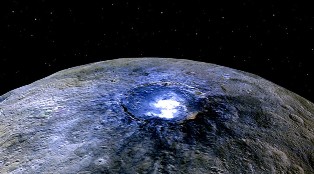
HONG KONG: The mystery of the “bright spots” on Ceres has finally been clarified in two new studies. Footage from NASA’s Dawn spacecraft illustrates (in false color) neon blue deposits of salts in more than 130 locations across the celestial body.

Taken by the frame camera on board the spacecraft, some 2,700 miles (4,400 km) away during a flyover, the photographs depict large deposits of hydrated magnesium sulfates. Known as Epsom salt on Earth, the deposit is widely utilized in many beauty, household and gardening-related uses.


You might also like

Tesla driverless system to use updated radar technology

12/09/2016

Apple to develop its own self-driving technology

10/09/2016

The video was released by NASA Jet Propulsion Laboratory to illustrate two studies, one by a team from the Max Planck Institute for Solar System Research in Germany, who counted 130 bright spots across the surface of Ceres, a dwarf planet that is only 584 miles (940 km) wide.

The researchers, led by Andreas Nathues from the Max Planck Institute for Solar System Research, believed that the false blue-color pigmentations of salt-rich surfaces formed when water-ice sublimated in the past. They also believe that the deposits were unearthed as the result of asteroid impact on the surface of the celestial body that lies in the asteroid belt between Mars and Jupiter.

“The global nature of Ceres’ bright spots suggests that this world has a subsurface layer that contains briny water-ice,” Nathues said.

Harboring the most saturated of Ceres bright spots is the 60-mile-wide (90 km) Occator Crater. Scientists have identified the blue light to be a type of hydrated magnesium sulfate known as hexahydrite. Scientists believe the crater to be among the youngest features on Ceres with an estimate age of about 78 million years old.

In the second study, members of the Dawn science team found evidence of ammonia-rich clays.

Related Stories

Tesla driverless system to use updated radar technology

byCT Report
12/09/2016

WASHINGTON: Electric carmaker Tesla announced Sunday it was upgrading its Autopilot software to use more advanced radar technology. In a...

Apple to develop its own self-driving technology

byCT Report
10/09/2016

SAN FRANCISCO: Apple may not become an automaker, but it still wants to develop its own self-driving technology. The iPhone-maker's...

NASA spots slowest known magnetar

byCT Report
10/09/2016

WASHINGTON: Astronomers have found evidence of a magnetar - magnetised neutron star - that spins much slower than the slowest...

‘YouTubers’ outshining old-school television

byCT Report
09/08/2016

SAN FRANCISCO: A media revolution is taking place, and most people over 35 years of age aren’t tuned in. Millennial...

Next Post

Chinese companies' investments in Japan on the climbe

  • Terms and Conditions
  • Disclaimer

© 2011 Customs Today -World's first newspaper on customs. Customs Today.

No Result
View All Result
  • Transfers and Postings
  • Latest News
  • Karachi
  • Islamabad
  • Lahore
  • National
  • Chambers & Associations
  • Business
  • About Us

© 2011 Customs Today -World's first newspaper on customs. Customs Today.