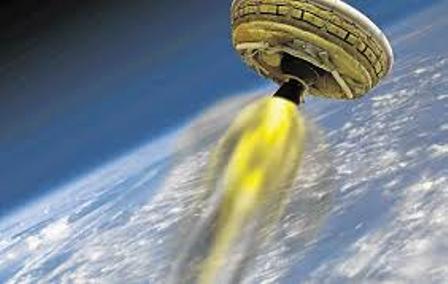


WASHINGTON: When the first astronauts land on Mars, they will not use a conventional parachute or heat shield that has been used before.
Instead, upon impacting the upper Martian atmosphere, a large inflatable saucer-shaped structure will slow their progress.
This is the low density supersonic decelerator (LDSD) and, in June, Nasa will perform the latest test of this groundbreaking technology – a vital next step in the journey to Mars. Today at 9am to 10am PDT (5pm to 6pm GMT), Nasa will perform a spin test of the vehicle at the Jet Propulsion Laboratory in California before transporting it to Hawaii.
The event will be streamed live on Ustream, and viewers will be able to ask questions on Twitter using the #AskNasa hashtag.
Ultimately, the vehicle will be sent into near-space from the Navy’s Pacific Missile Range Facility on Kauai, Hawaii, in June.
‘The LDSD crosscutting demonstration mission will test breakthrough technologies that will enable large payloads to be safely landed on the surface of Mars, or other planetary bodies with atmospheres, including Earth,’ Nasa said in a statement. ‘The technologies will not only enable landing of larger payloads on Mars, but also allow access to much more of the planet’s surface by enabling landings at higher-altitude sites.’
Esessentially parachute, the LDSD is large – 15ft (4.6 metres) wide and weighing 7,000lbs (3.200kg) – in order to cope with the atmosphere of Mars.
Earth has a reasonably thick atmosphere, so we can parachute relatively easily to the surface. But the Martian atmosphere is much thinner, so parachutes need to be much larger in order to create sufficient drag to land safely. The system is designed to land large vehicles on the surface of Mars. The Curiosity rover, for example, needed an innovative landing method due to its size but this technology wasn’t ready yet. Instead, to land the rover on the surface Nasa developed a landing mechanism that used rockets known as the ‘sky crane’. The LDSD, however, is an alternative way to reach the surface that will be able to land things that are bigger than Curiosity, such as equipment for a manned mission or humans themselves.

Karachi Port sets 138-year cargo handling record
KARACHI: Pakistan's maritime sector has achieved a major milestone as Karachi Port set a new record in its 138-year history...