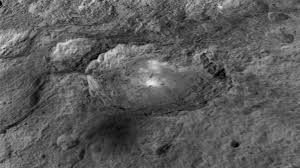
LONDON: NASA’s Dawn spacecraft successfully captured 3-D details of a pyramid-shaped mountain and bright spots on Ceres . The presence of bright spots might be water ice on this small spheroidal planet (606 by 565 miles in size).
This dwarf planet was first discovered by Giuseppe Piazzi of Italy on January 1, 1801 and rotates once in every 9 hours in the asteroid belt of our solar system. It is said to have a dense core and the outer surface contains materials that are lighter in weight.


This decade-long mission finally released a 3D video of Ceres revealing a 2 mile deep crater in the northern hemisphere named as Occator (derived from Roman agriculture). The peak of the mountain discovered in the southern hemisphere is expected to be 4 miles high which is as high as Mount McKinley in Denali National Park, Alaska, the highest point in North America as stated by the scientists of NASA.
The scientists are further investigating the bright spots and comparing them with different materials such as salt to evaluate the reflecting properties as stated by Chris Russell, Dawn’s principal investigator at the University of California, Los Angeles.