Customs Today
  • Home
  • Islamabad
  • Karachi
  • Lahore
  • National
  • Transfers and Postings
  • Chambers & Associations
  • Business
No Result
View All Result
Customs Today
  • Home
  • Islamabad
  • Karachi
  • Lahore
  • National
  • Transfers and Postings
  • Chambers & Associations
  • Business
No Result
View All Result
Customs Today
No Result
View All Result
Home Science & Technology Science

NASA captures closest images yet of dwarf planet Ceres

byCustoms Today Report
28/08/2015
in Science, Science & Technology
Share on FacebookShare on Twitter

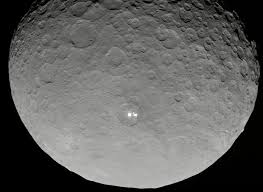
CANADA: Earlier this week, NASA released the latest batch of photos collected by the Dawn spacecraft of Ceres, and the new images provide the closest look yet at the large, cone-shaped mountain found in the southern hemisphere and other surface features of the dwarf planet.

While using its framing camera to map the dwarf planet’s surface at an orbital altitude of 915 miles (1,470 kilometers) on August 19, Dawn managed to get an up-close look at the four mile (six kilometer) tall mountain. The image was taken at a resolution of 450 feet (140 meters) per pixel, and reveals narrow, braided fractures and an unusual bright region.


You might also like

Tesla driverless system to use updated radar technology

12/09/2016

Apple to develop its own self-driving technology

10/09/2016

NASA also released images of a mountain ridge in the center of Urvara crater, and Gaue crater, a large crater with a sunken-in center. Urvara crater is 101 miles (163 kilometers) in diameter and was named after an Indian and Iranian deity of plants and fields, while Gaue crater is was named after a Germanic goddess and is 52 miles (84 kilometers) in diameter.

Dawn mapping gravity field in preparation for final orbit

At its current altitude, Dawn takes 11 days to capture and transmit images of Ceres’ surface back to Earth, according to NASA. Each of those 11-day cycles 14 orbits, the agency added, and over the next eight weeks, the spacecraft will successfully map the dwarf planet’s entire surface a total of six times. That data will allow NASA scientists to create 3D models of Ceres.

During this time, Dawn will also gather data can will provide new insight into the minerals found on the surface of Ceres using its visible and infrared mapping spectrometer instruments.


Related Stories

Tesla driverless system to use updated radar technology

byCT Report
12/09/2016

WASHINGTON: Electric carmaker Tesla announced Sunday it was upgrading its Autopilot software to use more advanced radar technology. In a...

Apple to develop its own self-driving technology

byCT Report
10/09/2016

SAN FRANCISCO: Apple may not become an automaker, but it still wants to develop its own self-driving technology. The iPhone-maker's...

NASA spots slowest known magnetar

byCT Report
10/09/2016

WASHINGTON: Astronomers have found evidence of a magnetar - magnetised neutron star - that spins much slower than the slowest...

‘YouTubers’ outshining old-school television

byCT Report
09/08/2016

SAN FRANCISCO: A media revolution is taking place, and most people over 35 years of age aren’t tuned in. Millennial...

Next Post

Tokyo stocks soars over 3.0% at end, Nikkei 225 jumps 3.03%

  • Terms and Conditions
  • Disclaimer

© 2011 Customs Today -World's first newspaper on customs. Customs Today.

No Result
View All Result
  • Transfers and Postings
  • Latest News
  • Karachi
  • Islamabad
  • Lahore
  • National
  • Chambers & Associations
  • Business
  • About Us

© 2011 Customs Today -World's first newspaper on customs. Customs Today.