

Customs Today
  • Home
  • Islamabad
  • Karachi
  • Lahore
  • National
  • Transfers and Postings
  • Chambers & Associations
  • Business
No Result
View All Result
Customs Today
  • Home
  • Islamabad
  • Karachi
  • Lahore
  • National
  • Transfers and Postings
  • Chambers & Associations
  • Business
No Result
View All Result
Customs Today
No Result
View All Result
Home Science & Technology Science

NASA discovered a fast-moving pulsar with a massive punch

byCustoms Today Report
24/07/2015
in Science, Science & Technology
Share on FacebookShare on Twitter

You might also like

Tesla driverless system to use updated radar technology

12/09/2016

Apple to develop its own self-driving technology

10/09/2016

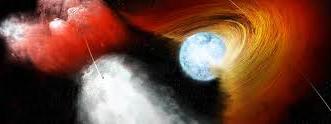
BRENT: NASA’s Chandra X-ray Observatory has discovered a fast-moving pulsar with a massive punch.
The pulsar seems to have punched a hole in a disk of gas around a star, launching disk fragments at a speed of over 6.4 million kilometres per hour.
NASA added that Chandra was tracking the clump, and it appears to be picking up speed as it moves out.
“The double star system PSR B1259-63/LS 2883 – or B1259 for short – contains a star about 30 times as massive as the Sun and a pulsar, an ultra-dense neutron star left behind when an even more massive star underwent a supernova explosion,” the space agency explained.
“These two objects are in an unusual cosmic arrangement and have given us a chance to witness something special,” said George Pavlov of Penn State University in State College, Pennsylvania, lead author of a paper describing these results.
“As the pulsar moved through the disk, it appears that it punched a clump of material out and flung it away into space.”
NASA said that while the clump spans roughly a hundred times the size of our Solar System, it’s rather thin. In fact, the material in it has the mass equivalent to all the water in Earth’s oceans, it said.
Three observations from Chandra show the clump moving away from B1259 at increasing speed. The first observation showed an average speed of about seven percent of the speed of light, but subsequent observations show it has accelerated to 15 percent of the speed of light.

Related Stories

Tesla driverless system to use updated radar technology

byCT Report
12/09/2016

WASHINGTON: Electric carmaker Tesla announced Sunday it was upgrading its Autopilot software to use more advanced radar technology. In a...

Apple to develop its own self-driving technology

byCT Report
10/09/2016

SAN FRANCISCO: Apple may not become an automaker, but it still wants to develop its own self-driving technology. The iPhone-maker's...

NASA spots slowest known magnetar

byCT Report
10/09/2016

WASHINGTON: Astronomers have found evidence of a magnetar - magnetised neutron star - that spins much slower than the slowest...

‘YouTubers’ outshining old-school television

byCT Report
09/08/2016

SAN FRANCISCO: A media revolution is taking place, and most people over 35 years of age aren’t tuned in. Millennial...

Next Post

US Export Import Bank Spends over $46.9m on Lobbying in Q2-2015

  • Terms and Conditions
  • Disclaimer

© 2011 Customs Today -World's first newspaper on customs. Customs Today.

No Result
View All Result
  • Transfers and Postings
  • Latest News
  • Karachi
  • Islamabad
  • Lahore
  • National
  • Chambers & Associations
  • Business
  • About Us

© 2011 Customs Today -World's first newspaper on customs. Customs Today.