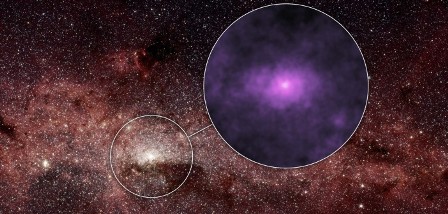
NEW YORK: Yesterday, NuSTAR provided startling new data about the center of our galaxy that is challenging scientists’ understanding of black holes and the effects they can have on nearby celestial bodies.
The centers of galaxies are complex, turbulent places made all the more complex by the fact that almost all of them seem to be home to black holes. But these aren’t your average stellar black holes, which average a measly 10 to 24 times the mass of our sun. These monster black holes have masses that are billions of times larger than nearby suns, and given their size, are theorized to be the main power source of their respective galaxies.


NASA’s Nuclear Spectroscopic Telescope Array, aka NuSTAR, carries out a census of collapsed stars and black holes in the Milky Way. Unsurprisingly, one of the most interesting places to study black holes is in the center of the Milky Way, where the biggest one in our neighborhood resides.
Supermassive black holes at the center of a galaxy can have billions of times the mass of the Sun
Previous research has shown that the inner few parsecs (a parsec is about 3.26 light years) of the galactic center is mostly home to white dwarfs, which are roughly the mass of the sun and emit “soft” or lower energy X-rays. However, the NuSTAR team has announced in a recent press release that they have detected a mysterious glow of unexplained “hard” or high-energy X-rays near the center of the Milky Way galaxy.
“We can’t definitively explain the X-ray signal yet – it’s a mystery. More work needs to be done,” said lead study author Kerstin Perez in the press release.