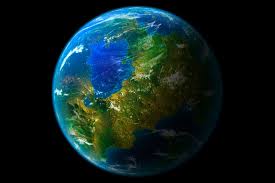
WASHINGTON: Earth has a few more near-twin planets outside our solar system, tantalizing possibilities in the search for extraterrestrial life. The other, Kepler 442-b, is about 34 percent bigger than Earth but gets only two-Astronomers has announced that depending on definitions, they have confirmed three or four more planets that are about the same size as Earth and are in the not-too-hot, not-too-cold “Goldilocks Zone” for liquid water to form.
These planets are likely to be rocky like Earth, and not gas giants or ice worlds. They get about the same heat from their star as we get from the sun, according to the latest results from NASA’s planet hunting Kepler telescope.


They may be close to Earth in size and likely temperature in the gargantuan scale of the universe, but they aren’t quite close enough for comfort, an astronomer at the Harvard-Smithsonian Center for Astrophysics. Those two are 500 and 1,100 light years away; a light year is 5.9 trillion miles.
Study co-author who presented the findings at the American Astronomical Society meeting in Seattle, is that astronomers are a bit closer to finding twins of Earth and answering the age-old question:
Torres’ team confirmed earlier discoveries and added new ones, bringing the total known number of planets that are no bigger than twice Earth’s size and in the habitable temperature zone to eight or nine. But that’s only from a short search of a small part of our galaxy, so Torres believes that Earth-like planets are common throughout the cosmos, though he cannot prove it yet.
Torres likes to include one planet that would bump the new findings from three to four, but Caldwell said that planet may or may not be habitable.
Torres and Caldwell highlighted the two new planets that are closest in size to Earth. The closest, called Kepler 438-b, is only 12 percent larger than Earth and gets about 40 percent more energy from its star than we do from the sun, so it would probably be warmer, Torres said. It tightly circles a small cooler red star with its year lasting only 35 Earth days and the sun in its sky would be red, not yellow.