

NEW YORK: Bad weather led the US space agency to postpone until Friday the first test of the largest parachute ever deployed, with the view of one day using it to land on Mars.
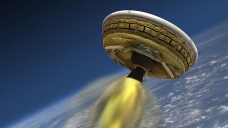
If conditions improve, the test flight of the flying saucer, known as the Low-Density Supersonic Decelerator, will be broadcast live on NASA´s website beginning at 1:30 pm (1730 GMT) on Friday.”A line of rain showers developed overnight moving towards the launch site, which result in unstable wind conditions near the surface that would prevent the launch of the balloon,” NASA said.
High ocean waves have already forced several delays to the launch, originally set for early this week.The launch window for the test extends until June 12.
NASA has been sending robotic spacecraft to Mars since the 1970s, but the new test involves a more advanced technology, known as the Supersonic Ringsail Parachute, that could allow even heavier spacecraft — the kind that may carry humans and months of food and supplies — to land softly on the Red Planet.
Since the atmosphere on Mars is so thin, any parachute that helps a heavy, fast-moving spacecraft touch down needs to be extra strong.
The test will involve sending the flying saucer, an inner-tube shaped decelerator and parachute to an altitude of 120,000 feet (37 kilometers) over the Pacific Ocean with the help of a giant balloon.
The balloon will release the spacecraft and rockets will lift the vehicle even higher, to 180,000 feet (55 kilometers), reaching supersonic speeds.
“Traveling at three times the speed of sound, the saucer´s decelerator will inflate, slowing the vehicle, and then a parachute will deploy at 2.35 times the speed of sound to carry it to the ocean´s surface,” NASA said.

Karachi Port sets 138-year cargo handling record
KARACHI: Pakistan's maritime sector has achieved a major milestone as Karachi Port set a new record in its 138-year history...