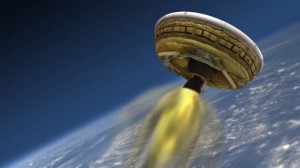


CANADA: The Low-Density Supersonic Decelerator is designed to safely ferry a team of astronauts down to the surface of Mars on a future human mission to the Red Planet. A test flight to examine the capabilities of the system, including the world’s largest parachute, was scheduled for June 2. However, a series of days with unfavorable weather conditions has resulted in a series of delays for the flight.
The LDSD test vehicle will be lifted to the edge of space by a massive balloon. Because of this system, weather conditions need to be near-perfect before mission planners are able to launch the tandem vehicle. Previous delays were caused by rough conditions on the ocean and rain showers at the launch site. On June 5, NASA delayed the launch once again, citing concerns over surface winds.
“Mission managers have postponed Friday’s, June 5, Low-Density Supersonic Decelerator launch due to unstable wind conditions near the surface that would prevent the launch of the balloon. NASA will evaluate the next available launch opportunity, Saturday, June 6,” Kim Newton wrote for NASA on its LDSD blog.
Once it is fully developed, the doughnut-shaped vehicle will be the only spacecraft capable of landing astronauts on the surface of the Red Planet. The shape of the craft, resembling a flying saucer, is designed to generate a large amount of drag as it courses through the thin atmosphere of Mars.
The 7,000-pound saucer will be further slowed down on the way to the surface by a pair of technologies. The first of these, the Supersonic Inflatable Aerodynamic Decelerator (SAID) is a ring which will expand to create additional drag, slowing the vehicle down to around 2.4 times faster than the speed of sound. At that point, the LDSD will deploy a supersonic parachute, the first space parachute to undergo a complete redesign since the Viking missions to Mars in the 1970s.
Further development of this new parachute design could lead to new landing systems on future Martian landings. Currently, NASA is planning on sending the first humans to Mars sometime during the 2030s.

Karachi Port sets 138-year cargo handling record
KARACHI: Pakistan's maritime sector has achieved a major milestone as Karachi Port set a new record in its 138-year history...