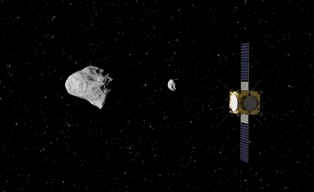


WASHINGTON: Since its arrival at comet 67P/Churyumov-Gerasimenko, the European Space Agency’s Rosetta spacecraft has been surveying the surface and the environment of this curiously shaped body. But for a long time, a portion of the nucleus — the dark, cold regions around the comet’s south pole — remained inaccessible to almost all instruments on the spacecraft.
Due to a combination of its double-lobed shape and the inclination of its rotation axis, Rosetta’s comet has a very peculiar seasonal pattern over its 6.5-year-long orbit. Seasons are distributed very unevenly between the two hemispheres. Each hemisphere comprise parts of both comet lobes and the “neck.”
For most of the comet’s orbit, the northern hemisphere experiences a very long summer, lasting over 5.5 years, while the southern hemisphere undergoes a long, dark and cold winter.
However, a few months before the comet reaches perihelion — the closest point to the sun along its orbit — the situation changes, and the southern hemisphere transitions to a brief and very hot summer.
When Rosetta arrived at 67P/C-G in August 2014, the comet was still experiencing its long summer in the northern hemisphere, and regions on the southern hemisphere received very little sunlight. Moreover, a large part of this hemisphere, close to the comet’s south pole, was in polar night and had been in total darkness for almost five years.
With no direct illumination from the sun, these regions could not be imaged with Rosetta’s OSIRIS (the Optical, Spectroscopic, and Infrared Remote Imaging System) science camera, or its Visible, InfraRed and Thermal Imaging Spectrometer (VIRTIS).
For the first several months after Rosetta’s arrival at the comet, only one instrument on the spacecraft could observe and characterize the cold southern pole of 67P/C-G: the Microwave Instrument for Rosetta Orbiter (MIRO).

Karachi Port sets 138-year cargo handling record
KARACHI: Pakistan's maritime sector has achieved a major milestone as Karachi Port set a new record in its 138-year history...