Customs Today
  • Home
  • Islamabad
  • Karachi
  • Lahore
  • National
  • Transfers and Postings
  • Chambers & Associations
  • Business
No Result
View All Result
Customs Today
  • Home
  • Islamabad
  • Karachi
  • Lahore
  • National
  • Transfers and Postings
  • Chambers & Associations
  • Business
No Result
View All Result
Customs Today
No Result
View All Result
Home Science & Technology Science

NASA introduces most ambitious 532,000-cubic-metre aerostatic balloon

byCustoms Today Report
02/01/2015
in Science
Share on FacebookShare on Twitter

You might also like

Astronomers discover distant dwarf planet beyond Neptune

12/07/2016

Nasa’s Juno successfully begins orbit of Jupiter

05/07/2016

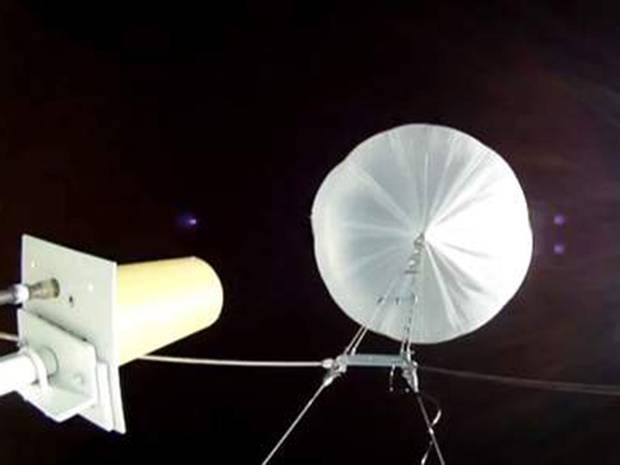
LONDON: NASA has taken the super-pressure balloon downward two days after launch due to a leak. The balloon landed on the Antarctic ice about 560 kilometers from McMurdo Station. Researchers hope to travel to the landing site to improve the gamma-ray telescope and the data it collected in its time aloft.
NASA has launched its most ambitious scientific balloon ever technicians inflated and released a 532,000-cubic-metre aerostatic balloon from near McMurdo Station in Antarctica. It is the biggest test yet of a ‘super-pressure’ design that enables a balloon to stay aloft much longer than a conventional scientific balloon.If all continues smoothly, experts expect the flight to last for 100 days or longer. The current record for the longest NASA scientific ballooning flight is 55 days, using a traditional balloon. The record for a super-pressure balloon is just a day shorter, at 54 days.
More time aloft equals more science. The new super-pressure balloon is carrying a γ-ray telescope to hunt for high-energy photons streaming from the cosmos. Known as the Compton Spectrometer and Imager (COSI), it can detect where in the sky these γ rays are coming from, and thus begin to unravel various astronomical mysteries.
COSI is the first science payload designed from scratch to take advantage of NASA’s super-pressure technology, says team leader Steven Boggs, an astrophysicist at the University of California, Berkeley. Its predecessors used liquid nitrogen to cool themselves, meaning that the nitrogen ran out in less than 10 days. COSI carries a mechanical cooler that contains nothing to run out of.
Related Stories

Astronomers discover distant dwarf planet beyond Neptune

byCT Report
12/07/2016

LONDON: A dwarf planet half the size of Britain has been found tumbling through space in the most distant reaches...


Nasa’s Juno successfully begins orbit of Jupiter

byCT Report
05/07/2016

MIAMI: Nasa's unmanned Juno spacecraft has begun orbiting Jupiter, a key triumph for a $1.1 billion mission that aims to...

Coal dust kills 23,000 per year in European countries

byCT Report
05/07/2016

PARIS: Lung-penetrating dust from coal-fired power plants in the European Union claims some 23,000 lives a year and racks up...

Helium shortage could be solved by new life-saving discovery

byCT Report
28/06/2016

LONDON: Scientists might finally have overcome a global shortage of helium – potentially saving millions of lives in the process....

Next Post

Android 5.0 Lollipop to release update for Galaxy S5, LG G3, Moto X, HTC One M8, Xperia Z3

  • Terms and Conditions
  • Disclaimer

© 2011 Customs Today -World's first newspaper on customs. Customs Today.

No Result
View All Result
  • Transfers and Postings
  • Latest News
  • Karachi
  • Islamabad
  • Lahore
  • National
  • Chambers & Associations
  • Business
  • About Us

© 2011 Customs Today -World's first newspaper on customs. Customs Today.