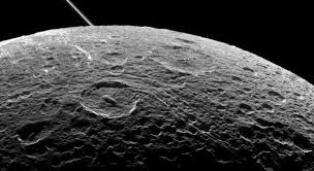


LONDON: A pockmarked, icy landscape looms beneath NASA’s Cassini spacecraft in new images of Saturn’s moon Dione taken during the mission’s last close approach to the small, icy world. Two of the new images show the surface of Dione at the best resolution ever.
Cassini passed 295 miles (474 kilometers) above Dione’s surface at 11:33 a.m. PDT (2:33 p.m. EDT) on Aug. 17.
This was the fifth close encounter with Dione during Cassini’s long tour at Saturn. The mission’s closest-ever flyby of Dione was in Dec. 2011, at a distance of 60 miles (100 kilometers).
“I am moved, as I know everyone else is, looking at these exquisite images of Dione’s surface and crescent, and knowing that they are the last we will see of this far-off world for a very long time to come,” said Carolyn Porco, Cassini imaging team lead at the Space Science Institute, Boulder, Colorado.
“Right down to the last, Cassini has faithfully delivered another extraordinary set of riches. How lucky we have been.”
Dione is small, about 1,120 km across, a third the size of our own Moon. Its density is low, meaning it’s mostly water ice, most likely with a smallish core of rock. In this image, taken when Cassini was still 170,000 km from the moon, gives you a sense of the beating it’s taken over the eons (this is a mosaic of nine separate images, one taken with a lower resolution camera, which is why part of the moon is blurrier). That big multiringed impact basin to the lower right is called Evander, and it’s about 350 km across. The hexagonal crater to its upper left is Sabinus; older, higher-resolution images show that the crater rim is slumped in, probably due to the low strength of the icy material. Many of the craters on Dione are low relief for that reason.

Karachi Port sets 138-year cargo handling record
KARACHI: Pakistan's maritime sector has achieved a major milestone as Karachi Port set a new record in its 138-year history...