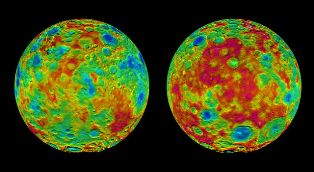


EUROPE: NASA’s Dawn spacecraft is giving scientists some interesting views and other data about the mysterious dwarf planet and they are still studying it. The latest color-coded topographic map of Ceres released by NASA given an in-depth knowledge of over a dozen recently approved names for features on the planet.
Ceres is the largest object in the asteroid belt, which lies between the orbits of Mars and Jupiter. Its diameter is approximately 945 kilometers (587 miles), making it the largest of the minor planets within the orbit of Neptune. The thirty-third largest known body in the Solar System, it is the only one identified orbiting entirely within the orbit of Neptune that is a dwarf planet. Composed of rock and ice, Ceres is estimated to comprise approximately one third of the mass of the entire asteroid belt.
A second Ceres map, in false color, highlights compositional differences present on the surface. This week at the European Planetary Science Conference in Nantes, France, the mysteries and insights about Ceres are being discussed.
These approved names are all eponymous for agricultural spirits, deities and festivals from cultures around the world.These include Jaja, after the Abkhazian harvest goddess, and Ernutet, after the cobra-headed Egyptian harvest goddess. A 12-mile (20-kilometer) diameter mountain near Ceres’ north pole is now called Ysolo Mons, for an Albanian festival that marks the first day of the eggplant harvest.
Chris Russell, Dawn principal investigator at the University of California, Los Angeles said, “Ceres continues to amaze, yet puzzle us, as we examine our multitude of images, spectra and now energetic particle bursts.”

Karachi Port sets 138-year cargo handling record
KARACHI: Pakistan's maritime sector has achieved a major milestone as Karachi Port set a new record in its 138-year history...