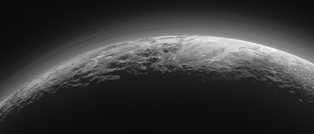


EUROPE: NASA’S Cassini spacecraft has returned the closest ever view of the Saturnian moon Enceladus’ north polar region as part of a data transmission from the spacecraft following the first of three close passes of the icy body. The flyby took place on Oct. 14, and saw the orbiter pass within 1,142 miles (1,839 km) of the enigmatic Moon.
Having explored Saturn and her many satellites for over 18 years, the orbiter is now reaching the point where it is saying its final farewells to the celestial bodies that have been the focus of its operational life.
Despite its long campaign, and the inevitability of its impending termination, the veteran spacecraft is still granting us stunning views and scientific insights regarding some of Saturn’s strangest moons. The recent images returned by Cassini represent the most detailed views ever captured of the north polar region of Enceladus.
During earlier flybys, this area has been shrouded in darkness as the region transitioned through its winter phase, preventing the probe from making detailed observations. However, during the recent pass the pole was illuminated, allowing the spacecraft to get the first close up look at the surface features marking the expanse.
Previous lower-resolution images of the northern region, taken by the Voyager spacecraft, had led scientists to expect it take on a cratered appearance.
“The northern regions are crisscrossed by a spidery network of gossamer-thin cracks that slice through the craters,” says Paul Helfenstein of the Cassini imaging team at Cornell University, Ithaca, New York. “These thin cracks are ubiquitous on Enceladus, and now we see that they extend across the northern terrains as well.”

Karachi Port sets 138-year cargo handling record
KARACHI: Pakistan's maritime sector has achieved a major milestone as Karachi Port set a new record in its 138-year history...