

HONG KONG: Astronomers using NASA’s Chandra X-ray Observatory have discovered an intriguing cosmic object that may help provide answers to some long-standing questions about how black holes evolve and influence their surroundings.
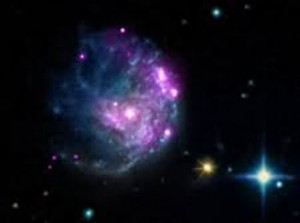
The object, called NGC2276-3c, is located in an arm of the spiral galaxy NGC 2276-3c which is about 100 million light years from the Earth.
“Astronomers have been looking very hard for these medium-sized black holes. There have been hints that they exist, but the IMBHs have been acting like a long-lost relative that is not interested in being found,” said study co-author Tim Roberts from the University of Durham in Britain.
Like paleontology, “we often have to ‘dig’ up our discoveries in galaxies that are millions of light years away”, added Mar Mezcua from the Harvard-Smithsonian Centre for Astrophysics who led the study.
For many years, scientists have found conclusive evidence for smaller black holes that contain about five to 30 times the mass of the sun.
There is also a lot of information about so-called supermassive holes that reside at the centre of galaxies and weigh million or even billion times the Sun’s mass.
As their name suggests, IMBHs represent a class of black holes that fall in between these two well-established groups, with masses in the range of a few hundred to a few hundred thousand solar masses.
One reason that IMBHs are important is that they could be the seeds from which supermassive black holes formed in the early universe.
“We found that NGC2276-3c has traits similar to both stellar-mass black holes and supermassive black holes,” said co-author Andrei Lobanov of the Max Planck Institute for Radio Astronomy in Bonn, Germany.

Karachi Port sets 138-year cargo handling record
KARACHI: Pakistan's maritime sector has achieved a major milestone as Karachi Port set a new record in its 138-year history...