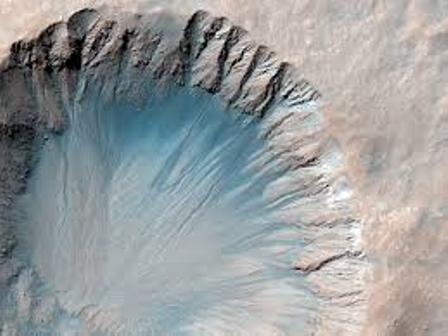
Mars may have liquid water close to its surface, according to new data from NASA’s Curiosity rover which raises the chance of finding life on the red planet. Researchers have long known that there was water in the form of ice on Mars. Now, new research on data from Curiosity shows that it is possible that there is liquid water close to the surface of Mars.
The explanation is that the substance perchlorate has been found in the soil, which lowers the freezing point so the water does not freeze into ice, but is liquid and present in very salty salt water – a brine. “We have discovered the substance calcium perchlorate in the soil and, under the right conditions, it absorbs water vapour from the atmosphere,” said Morten Bo Madsen, associate professor and head of the Mars Group at the Niels Bohr Institute at the University of Copenhagen.


“Our measurements from the Curiosity rover’s weather monitoring station show that these conditions exist at night and just after sunrise in the winter. Based on measurements of humidity and the temperature at a height of 1.6 meters and at the surface of the planet, we can estimate the amount of water that is absorbed,” said Madsen.
Madsen said when night falls, some of the water vapour in the atmosphere condenses on the planet surface as frost, but calcium perchlorate is very absorbent and it forms a brine with the water, so the freezing point is lowered and the frost can turn into a liquid.
“The soil is porous, so what we are seeing is that the water seeps down through the soil. Over time, other salts may also dissolve in the soil and now that they are liquid, they can move and precipitate elsewhere under the surface,” said Madsen. Observations by the Mars probe’s stereo camera have previously shown areas characteristic of old riverbed that clearly show that a long time ago there was flowing, running water with a depth of up to one meter.
Now the new close-up images taken by the rover all the way en route to Mount Sharp show that there are expanses of sedimentary deposits, lying as ‘plates’ one above the other and leaning a bit toward Mount Sharp. “These kind of deposits are formed when large amounts of water flow down the slopes of the crater and these streams of
water meet the stagnant water in the form of a lake. When the stream meets the surface, the solid material carried by the stream falls down and is deposited in the lake just at the lakeshore.
Gradually, a slightly inclined slope is built up just below the surface of the water and traces of such slanting deposits were found during the entire trip to Mount Sharp. Very fine-grained sediments, which slowly fell down through the water, were deposited right at the very bottom of the crater lake. “The sediment plates on the bottom are level, so
everything indicates that the entire Gale Crater may have been a large lake,” Madsen added.