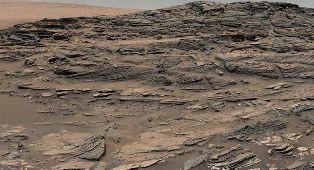


HONG KONG: NASA’s Curiosity Mars rover has uncovered some pretty interesting details about the terrain of the planet. Some of the dark sandstone shows texture and inclined bedding structures characteristic of deposits that formed as sand dunes, then were cemented into rock.
This sandstone outcrop is all part of a geological layer that Curiosity’s science team has labeled the Stimson unit. It has a structure called crossbedding on a large scale that the team has classified as deposits of sand dunes formed by wind. Petrified sand dunes that appear to be very physically similar are a common occurrence in the U.S. Southwest. Geometry and orientation of the crossbedding illustrates certain information about the directions of the winds that produced the dunes.
The Stimson unit overlies a layer of mudstone that was deposited in a lake environment. Curiosity Mars rover has been examining successively higher and younger layers of Mount Sharp, first beginning with the mudstone at the mountain’s base, for evidence about changes in the area’s ancient environment.
The dozens of individual Mastcam images combined into this panorama were taken on August 27th, 2015. Curiosity has driven about 103 yards (94 meters) in the subsequent two weeks, generally southward. Outcrops of the Stimson unit sandstone are still accessible to the rover, and researchers plan to use the rover to collect and analyze a drilled sample of Stimson unit sandstone this month.
Curiosity has been on the surface of Mars scanning the environment since early August 2012. It reached the base of Mount Sharp last year after fruitfully investigating outcrops closer to its landing site and then trekking to the mountain.

Karachi Port sets 138-year cargo handling record
KARACHI: Pakistan's maritime sector has achieved a major milestone as Karachi Port set a new record in its 138-year history...