

Customs Today
  • Home
  • Islamabad
  • Karachi
  • Lahore
  • National
  • Transfers and Postings
  • Chambers & Associations
  • Business
No Result
View All Result
Customs Today
  • Home
  • Islamabad
  • Karachi
  • Lahore
  • National
  • Transfers and Postings
  • Chambers & Associations
  • Business
No Result
View All Result
Customs Today
No Result
View All Result
Home Science & Technology Science

NASA’s Dawn probe stays in its current orbit around the dwarf planet

byCustoms Today Report
11/07/2015
in Science, Science & Technology
Share on FacebookShare on Twitter

You might also like

Tesla driverless system to use updated radar technology

12/09/2016

Apple to develop its own self-driving technology

10/09/2016

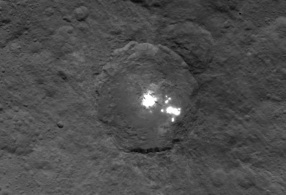
EUROPE: NASA’s Dawn probe is staying in its current orbit around the dwarf planet Ceres a bit longer than originally planned while engineers try to figure out why the probe went into a precautionary “safe mode” last week.
Just after Dawn fired up its ion engines to begin spiraling down toward its third science orbit of Ceres on June 30, the spacecraft’s protective software detected a problem of some sort, NASA said. As a result, Dawn shut off its engines and went into safe mode.
Mission team members got the probe back up and running over the next two days. Dawn is healthy and out of safe mode, but it’s staying put for now.
“Dawn will remain at its current orbital altitude until the operations team has completed an analysis of what occurred and has updated the flight plan,” NASA officials wrote in a mission update on Monday.
The $466 million Dawn mission launched in September 2007 to perform up-close investigations of Vesta and Ceres, the two largest objects in the main asteroid belt beween Mars and Jupiter. Dawn orbited Vesta from July 2011 through September 2012 and arrived at the 590-mile-wide (950-kilometer-wide) Ceres in March.
Dawn is studying Ceres from a quartet of progressively closer-in orbits. The spacecraft currently circles the dwarf planet at a distance of 2,700 miles (4,400 kilometers); the third science orbit lies 900 miles (1,450 kilometers) from Ceres.

Related Stories

Tesla driverless system to use updated radar technology

byCT Report
12/09/2016

WASHINGTON: Electric carmaker Tesla announced Sunday it was upgrading its Autopilot software to use more advanced radar technology. In a...

Apple to develop its own self-driving technology

byCT Report
10/09/2016

SAN FRANCISCO: Apple may not become an automaker, but it still wants to develop its own self-driving technology. The iPhone-maker's...

NASA spots slowest known magnetar

byCT Report
10/09/2016

WASHINGTON: Astronomers have found evidence of a magnetar - magnetised neutron star - that spins much slower than the slowest...

‘YouTubers’ outshining old-school television

byCT Report
09/08/2016

SAN FRANCISCO: A media revolution is taking place, and most people over 35 years of age aren’t tuned in. Millennial...

Next Post

Taiwan’s Innolux Corp revenue falls 6.395 to NT$93.76b in June

  • Terms and Conditions
  • Disclaimer

© 2011 Customs Today -World's first newspaper on customs. Customs Today.

No Result
View All Result
  • Transfers and Postings
  • Latest News
  • Karachi
  • Islamabad
  • Lahore
  • National
  • Chambers & Associations
  • Business
  • About Us

© 2011 Customs Today -World's first newspaper on customs. Customs Today.