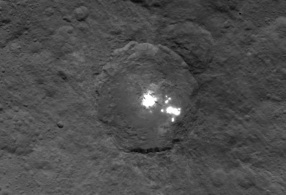
CANADA: NASA’s Dawn spacecraft, nearly halfway through its exploration of the dwarf planet Ceres, has returned its best images yet of a mysterious grouping of bright spots inside a crater on the Texas-sized world, bolstering evidence that Ceres is geologically alive.
Six months after its arrival at Ceres, the Dawn probe is now circling the frozen dwarf planet at a distance of about 915 miles (1,470 kilometers), the third of four orbits taking the spacecraft progressively closer to Ceres.
The view of a crater named Occator released Wednesday is the sharpest view yet of bright spots first resolved as Dawn approached Ceres. The features are part of a complex structure that scientists say is strong evidence that the dwarf planet — the biggest object in the asteroid belt between Mars and Jupiter — remains geologically active.
“Dawn has transformed what was so recently a few bright dots into a complex and beautiful, gleaming landscape,” said Marc Rayman, Dawn’s chief engineer and mission director based at NASA’s Jet Propulsion Laboratory, Pasadena, California. “Soon, the scientific analysis will reveal the geological and chemical nature of this mysterious and mesmerizing extraterrestrial scenery.”
Analysts combined two images of Occator crater, one with exposure settings to resolve the bright spots and another to add detail from the darker surrounding terrain. The image has a resolution of 450 feet, or 140 meters, about three times better than images from Dawn’s last mapping campaign from a higher orbit in June.
Researchers are not sure what the bright spots are, but NASA has started an online poll for the public to cast their predictions. The options in the poll include ice, salts, rock, a volcano, or a geyser.
Dawn has located a four-mile-high pyramid-shaped mountain on another part of Ceres. Bright streaks along the flank of the peak have also caught the attention of scientists looking for exposed ice deposits.
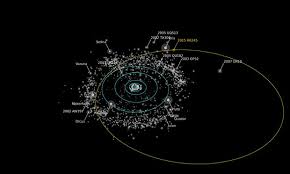
Astronomers discover distant dwarf planet beyond Neptune
LONDON: A dwarf planet half the size of Britain has been found tumbling through space in the most distant reaches...