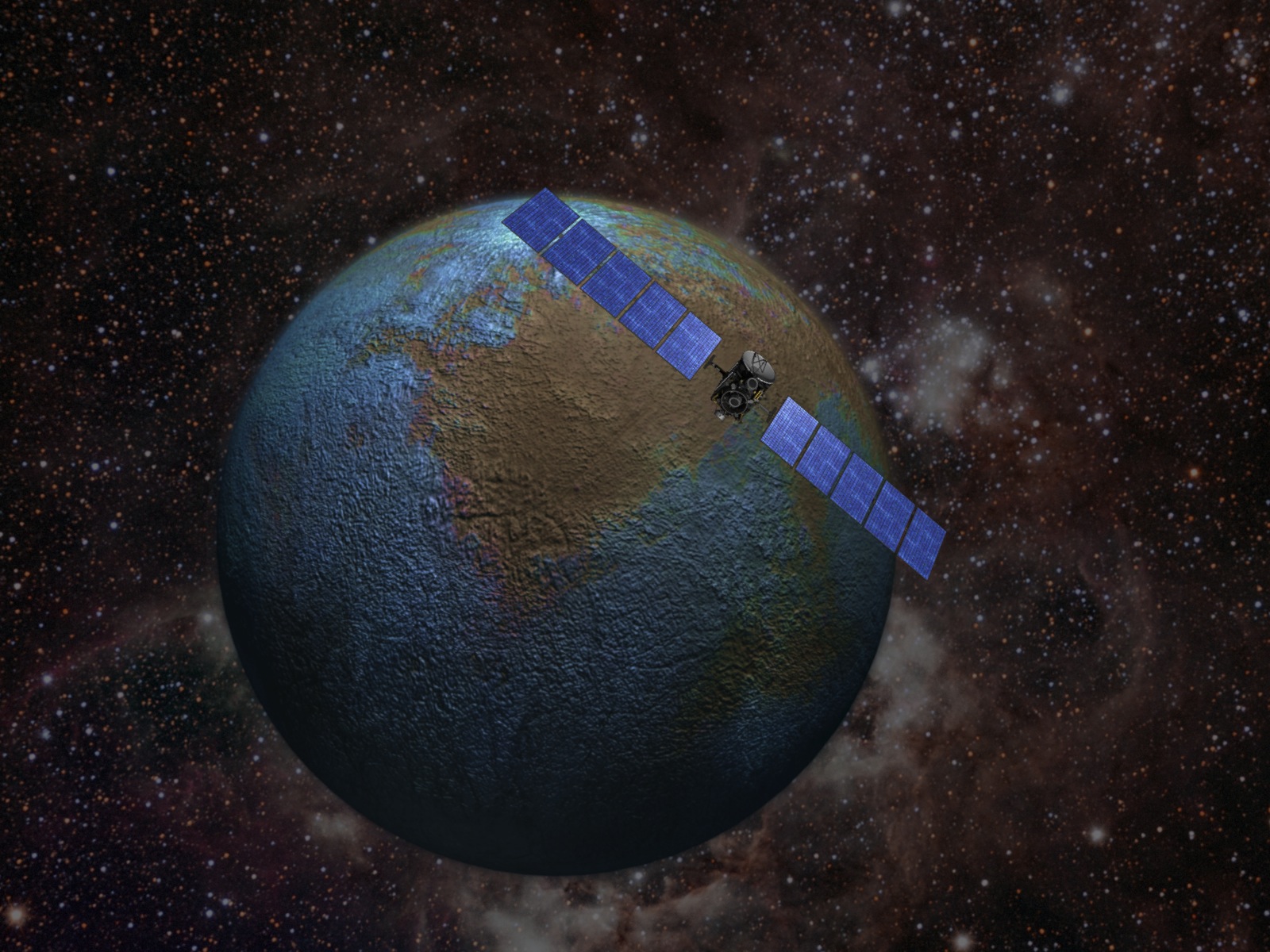


PARIS: The largest dwarf planet in the Asteroid Belt, Ceres, is going to be charted soon by NASA’s Dawn, as the spacecraft has started its final approach to the asteroid. NASA’s solar-charged probe is scheduled to touch base in March, when Ceres will catch the spacecraft in orbit.
Dawn only recently regained the ability to communicate fully with its handlers since it emerged from solar conjunction, when it was traveling on the opposite side of the Sun. The emergence allowed mission controllers to program the necessary maneuvers for the next stage of Dawn’s approach to Ceres.
At present, Dawn is some 400,000 miles (640,000 kilometers) from Ceres, according to a report by Phys.org. The spacecraft is speeding toward the dwarf planet at about 450 miles (725 kilometers) per hour.
From 2011 to 2012, Dawn explored the protoplanet Vesta, one of the largest asteroids in the solar system, second only to Ceres, whose mysteries are yet to be unveiled.
“Ceres is almost a complete mystery to us,” said Christopher Russell, principal investigator for the Dawn mission, in the Phys.org report. “Ceres, unlike Vesta, has no meteorites linked to it to help reveal its secrets. All we can predict with confidence is that we will be surprised.”
Scientists believe Ceres and Vesta differ in important ways. While Vesta, thought to be the oldest of the two, retained little water from the time of its formation, Ceres has a thick mantle of ice and could even have a liquid ocean lying beneath it–giving rise to speculation about its potential for harboring extraterrestrial life.
Instead of using conventional chemical propulsion, Dawn uses much more efficient ion propulsion to travel through space.
“Orbiting both Vesta and Ceres would be truly impossible with conventional propulsion,” said chief engineer and mission director Marc Rayman, based at NASA’s Jet Propulsion Laboratory in Pasadena, California, in the Phys.org report.
Stay tuned over the next couple of months for new, more detailed images of Ceres coming from Dawn as it closes in on this never-before-seen miniature planet.

Karachi Port sets 138-year cargo handling record
KARACHI: Pakistan's maritime sector has achieved a major milestone as Karachi Port set a new record in its 138-year history...