

Customs Today
  • Home
  • Islamabad
  • Karachi
  • Lahore
  • National
  • Transfers and Postings
  • Chambers & Associations
  • Business
No Result
View All Result
Customs Today
  • Home
  • Islamabad
  • Karachi
  • Lahore
  • National
  • Transfers and Postings
  • Chambers & Associations
  • Business
No Result
View All Result
Customs Today
No Result
View All Result
Home Uncategorized

NASA’s Hubble Telescope detects stratosphere on distant blazing hot exoplanet

byCustoms Today Report
17/06/2015
in Uncategorized
Share on FacebookShare on Twitter

You might also like

Pakistan to get $3b loan from Islamic Trade Financing Corporation

20/10/2024

Lahore I&I & Enforcement anti-smuggling operations achieve record success in early FY 2024-25

10/09/2024

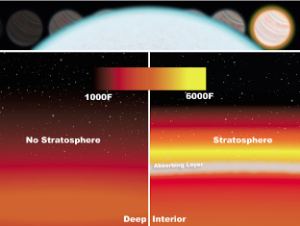
NEW YORK: Stratosphere has been discovered on a distant blazing-hot exoplanet dubbed WASP-33b by NASA’s Hubble Space Telescope – a discovery that scientists claim will enable them to learn more about the composition of a planet and how it formed.
This discovery was unexpected as scientists were unsure whether such an atmospheric layer would be found in the atmospheres of large, extremely hot planets in other star systems.
Though stratosphere would require a book of its own to describe, here is a little primer. In Earth’s atmosphere, the stratosphere sits above the troposphere — the turbulent, active-weather region that reaches from the ground to the altitude where nearly all clouds top out. In the troposphere, the temperature is warmer at the bottom — ground level — and cools down at higher altitudes.
The stratosphere is just the opposite. In this layer, the temperature increases with altitude, a phenomenon called temperature inversion. On Earth, temperature inversion occurs because ozone in the stratosphere absorbs much of the Sun’s ultraviolet radiation, preventing it from reaching the surface, protecting the biosphere, and therefore warming the stratosphere instead.
Similar temperature inversions occur in the stratospheres of other planets in our solar system, such as Jupiter and Saturn. In these cases, the culprit is a different group of molecules called hydrocarbons. Neither ozone nor hydrocarbons, however, could survive at the high temperatures of most known exoplanets, which are planets outside our solar system. This leads to a debate as to whether stratospheres would exist on them at all.


Related Stories

Pakistan to get $3b loan from Islamic Trade Financing Corporation

byCT Report
20/10/2024

ISLAMABAD: Islamic Trade Financing Corporation (ITFC) to provide Pakistan with a $3 billion loan, according to an official statement released...

Lahore I&I & Enforcement anti-smuggling operations achieve record success in early FY 2024-25

byCT Report
10/09/2024

LAHORE:  Regional Directorate of Customs Intelligence & Investigation has demonstrated exceptional performance in the first two months of the fiscal...

ICCI and CDA to join hands for tree plantation drive in Capital

byQaisar Mansoor
09/08/2023

ISLAMABAD: Islamabad Chamber of Commerce and Industry (ICCI) in collaboration with the Capital Development Authority (CDA) would jointly launch a...

Customs Officials Yawar Abbas & Tariq Mehmood kidnapped in Karachi

byCT Report
08/07/2023

KARACHI: Customs Intelligence Officer Yawar Abbas and Customs Preventive Officer Tariq Mehmood who were working against smuggling were kidnapped by...

Next Post

‘Asir-e-Siyad’: Ayyan Ali writing memoir in jail

  • Terms and Conditions
  • Disclaimer

© 2011 Customs Today -World's first newspaper on customs. Customs Today.

No Result
View All Result
  • Transfers and Postings
  • Latest News
  • Karachi
  • Islamabad
  • Lahore
  • National
  • Chambers & Associations
  • Business
  • About Us

© 2011 Customs Today -World's first newspaper on customs. Customs Today.