

FRANCE: The bat-winged MAVEN spacecraft has now been in orbit for six months, dipping in and out of the Red Planet’s atmosphere in a looping orbit that slowly shifts around the planet. It’s investigating what goes on in Mars’s atmosphere and how the planet loses atmosphere over time.
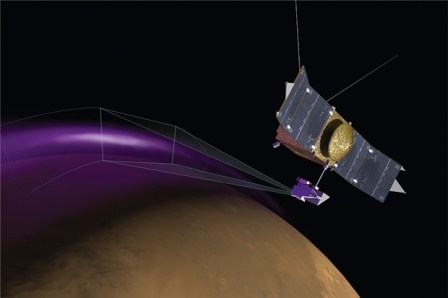
This artist’s conception shows MAVEN’s Imaging Ultraviolet Spectrograph (IUVS) observing the “Christmas Lights Aurora” (purple) on Mars. The aurora persisted for five days and were detected at ultraviolet wavelengths.
As part of that investigation, it’s now found two intriguing features high above the planet’s surface: dust and auroras.
MAVEN found the dust indirectly, by what grains do to the spacecraft when they hit it, explains mission principal investigator Bruce Jakosky (University of Colorado Boulder). When a speedy dust mote hits hard enough to vaporize and ionize its bits, the aftermath affects the spacecraft’s electrical potential and creates a milliseconds-long signature that the Langmuir Probe and Waves (LPW) instrument can detect.
The spacecraft has now completed more than 800 orbits around Mars, and the team has detected these dust impacts ever since turning on the instrument. But they don’t see the dust everywhere: MAVEN’s orbit precesses around Mars, meaning that over time the spacecraft’s closest point to the surface moves around the planet. LPW detected dust near local dawn and dusk, but not at night. “That’s an important clue, but we haven’t yet figured out how to interpret it,” Jakosky says.
The dust also seems unconnected to the surface features below. That’s unsurprising, Jakosky says, given that the dust is generally concentrated between 150 and 500 kilometers (90 and 300 miles) above the surface — it also occasionally shows up as high as 1,000 km — and it’s hard to imagine how something on the surface could affect things that high up.

Karachi Port sets 138-year cargo handling record
KARACHI: Pakistan's maritime sector has achieved a major milestone as Karachi Port set a new record in its 138-year history...