Customs Today
  • Home
  • Islamabad
  • Karachi
  • Lahore
  • National
  • Transfers and Postings
  • Chambers & Associations
  • Business
No Result
View All Result
Customs Today
  • Home
  • Islamabad
  • Karachi
  • Lahore
  • National
  • Transfers and Postings
  • Chambers & Associations
  • Business
No Result
View All Result
Customs Today
No Result
View All Result
Home Science & Technology Science

NASA’s New Horizons spacecraft completes record-setting Kuiper Belt targeting maneuvers

byCustoms Today Report
07/11/2015
in Science, Science & Technology
Share on FacebookShare on Twitter

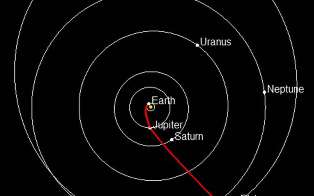
LONDON: NASA’s New Horizons spacecraft has successfully performed the last in a series of four targeting maneuvers that set it on course for a January 2019 encounter with 2014 MU69. This ancient body in the Kuiper Belt is more than a billion miles beyond Pluto; New Horizons will explore it if NASA approves an extended mission.

The four propulsive maneuvers were the most distant trajectory corrections ever performed by any spacecraft. The fourth maneuver, programmed into the spacecraft’s computers and executed with New Horizons’ hydrazine-fueled thrusters, started at approximately 1:15 p.m. EST on Wednesday, Nov. 4, and lasted just under 20 minutes. Spacecraft operators at the Johns Hopkins University Applied Physics Laboratory (APL) in Laurel, Maryland, began receiving data through NASA’s Deep Space Network just before 7 p.m. EST on Wednesday indicating the final targeting maneuver went as planned.


You might also like

Tesla driverless system to use updated radar technology

12/09/2016

Apple to develop its own self-driving technology

10/09/2016

The maneuvers didn’t speed or slow the spacecraft as much as they “pushed” New Horizons sideways, giving it a 57 meter per second (128 mile per hour) nudge toward the KBO. That’s enough to make New Horizons intercept MU69 in just over three years.

“This is another milestone in the life of an already successful mission that’s returning exciting new data every day,” said Curt Niebur, New Horizons program scientist at NASA Headquarters in Washington. “These course adjustments preserve the option of studying an even more distant object in the future, as New Horizons continues its remarkable journey.”


Related Stories

Tesla driverless system to use updated radar technology

byCT Report
12/09/2016

WASHINGTON: Electric carmaker Tesla announced Sunday it was upgrading its Autopilot software to use more advanced radar technology. In a...

Apple to develop its own self-driving technology

byCT Report
10/09/2016

SAN FRANCISCO: Apple may not become an automaker, but it still wants to develop its own self-driving technology. The iPhone-maker's...

NASA spots slowest known magnetar

byCT Report
10/09/2016

WASHINGTON: Astronomers have found evidence of a magnetar - magnetised neutron star - that spins much slower than the slowest...

‘YouTubers’ outshining old-school television

byCT Report
09/08/2016

SAN FRANCISCO: A media revolution is taking place, and most people over 35 years of age aren’t tuned in. Millennial...

Next Post

REC Solar increases shipments by 100MW in Q3

  • Terms and Conditions
  • Disclaimer

© 2011 Customs Today -World's first newspaper on customs. Customs Today.

No Result
View All Result
  • Transfers and Postings
  • Latest News
  • Karachi
  • Islamabad
  • Lahore
  • National
  • Chambers & Associations
  • Business
  • About Us

© 2011 Customs Today -World's first newspaper on customs. Customs Today.