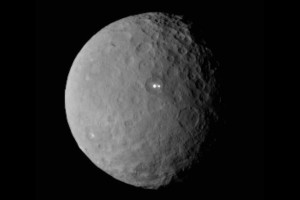


LONDON: NASA’s Dawn spacecraft has beamed home the best-ever photo of the mysterious bright spots that speckle the surface of the dwarf planet Ceres.
The new image resolves Ceres’ strange spots, which are found inside a crater about 55 miles (90 kilometers) wide, into a cluster composed of several patches, some of which were not visible in previous photos. But it doesn’t solve the mystery of the spots’ origin and composition.
“At least eight spots can be seen next to the largest bright area, which scientists think is approximately 6 miles (9 kilometers) wide,” NASA officials wrote in a statement on Monday. “A highly reflective material is responsible for these spots — ice and salt are leading possibilities, but scientists are considering other options, too.
Dawn captured the photo on June 9 from a distance of 2,700 miles (4,400 kilometers) — the altitude of its second mapping orbit of Ceres. Additional newly released photos taken from this orbit show other intriguing features, including a steep-sided mountain that rises about 3 miles (5 kilometers) from the dwarf planet’s heavily cratered surface and has been nicknamed the “pyramid.”

Karachi Port sets 138-year cargo handling record
KARACHI: Pakistan's maritime sector has achieved a major milestone as Karachi Port set a new record in its 138-year history...