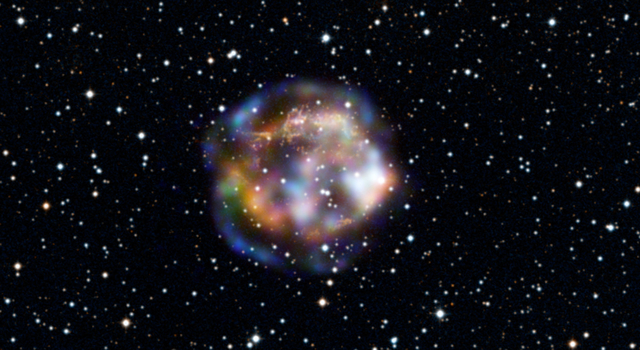
LONDON: New data from NASA’s Nuclear Spectroscopic Telescope Array (NuSTAR) indicates that a massive star exploded in a lopsided way, the most convincing evidence yet put forward for this phenomenon.
Most stars aren’t massive enough to fuse heavier elements and eventually fizzle out into white dwarfs. Some, however, have a much more spectacular ultimate fate. The biggest stars in the Universe quickly go through the Periodic Table (in just about 10 million years) up until iron, at which point fusion stops, their core collapses under the effect of gravity, followed by the outer layers which crash into it and rebound with enormous energy, shooting out space and leaving behind an extremely dense stellar remnant (either a neutron star or a black hole). This is what’s called a Type II (or core collapse) supernova and is the final stage in the lifetime of stars which have at least eight times the mass of our Sun.
You might also like


Stars are of course spherical objects, so you’d expect these explosions would scatter debris about equally in all directions. It seems, however, that the stellar core is extremely unstable just before going supernova, so it isn’t exactly in the center when that happens. This explains why the core blasts off in one direction, while the ejected material mostly goes the other way.