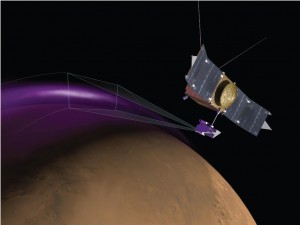
NEW YORK: Nasa’s Mars Atmosphere and Volatile Evolution (MAVEN) spacecraft has noticed mysterious high-altitude dust cloud and aurora that reaches deep into the Martian atmosphere.
The presence of the dust at orbital altitudes from 150 km to 300 km above the surface was not predicted earlier.


Although the source and composition of the dust are unknown, there is no hazard to MAVEN and other spacecraft orbiting Mars.
“If the dust originates from the atmosphere, this suggests we are missing some fundamental process in the Martian atmosphere,” said Laila Andersson from the University of Colorado’s Laboratory for Atmospherics and Space Physics (CU LASP), Boulder, Colorado.
It is unknown if the cloud is a temporary phenomenon or something long lasting.
The cloud density is greatest at lower altitudes.
However, even in the densest areas, it is still very thin.
So far, no indication of its presence has been seen in observations from any of the other MAVEN instruments.
Possible sources for the observed dust include dust wafted up from the atmosphere; dust coming from Phobos and Deimos, the two moons of Mars; dust moving in the solar wind away from the sun; or debris orbiting the sun from comets.
However, no known process on Mars can explain the appearance of dust in the observed locations from any of these sources.
Earlier, MAVEN’s Imaging Ultraviolet Spectrograph (IUVS) observed what scientists have named “Christmas lights”.
“What is especially surprising about the aurora we saw is how deep in the atmosphere it occurs – much deeper than at Earth or elsewhere on Mars,” added Arnaud Stiepen from the University of Colorado.
The source of the energetic particles appears to be the sun.
Billions of years ago, Mars lost a global protective magnetic field like Earth has, so solar particles can directly strike the atmosphere.
The electrons producing the aurora have about 100 times more energy than you get from a spark of house current, so they can penetrate deeply in the atmosphere.
The findings were presented at the 46th Lunar and Planetary Science Conference in the Woodlands, Texas recently.