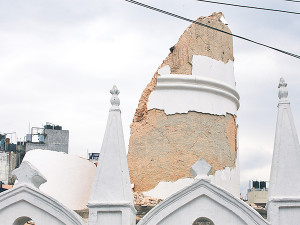
KATHMANDU: Setting an ambitious target of concluding the reconstruction drive in the next five years, the budget for 2015-16 has given a big priority to the rebuilding of quake-hit infrastructure. The government has allocated a whopping Rs91billion—more than 11 percent of the total budget of Rs819.47 billion—for the reconstruction initiative.
The devastating April 25 earthquake has significantly affected a number of physical infrastructures and homes.

Of the total amount, Rs74 billion has been allocated for the formation of the “National Reconstruction Fund” to be mobilised by the National Reconstruction Authority headed by Prime Minister Sushil Koirala.
To make sure the reconstruction initiative moves ahead smoothly, the government has allocated Rs17 billion that can be mobilised even in the absence of the authority.
Former finance secretary Rameshwar Khanal said the government has set priorities based on the needs. “The role of the Chief Executive Officer (CEO) of the Reconstruction Authority will be crucial. Hence, the government should cautiously choose a CEO who is efficient enough to helm the reconstruction drive,” he said.
“The budget has rightly pointed out the initiatives to be taken for the reconstruction drive,” said Chandra Mani Adhikari, a member of the National Planning Commission (NPC). “Implementation will be key.”
He said the massive allocation for reconstruction can be only utilised if the National Reconstruction Authority is formed timely. Though the authority to be headed by Prime Minister Sushil Koirala has been established, there has been no concrete development after that.
Of the amount allocated for the National Reconstruction Fund, Rs50 billion has been allotted for the housing sector. A total of 602,257 private houses have been completely destroyed, while 285,099 houses have been damaged partially by the earthquake.
A sum of Rs3 billion will go for public building, Rs2 billion for heritage infrastructure, Rs7 billion for other infrastructure, Rs6 billion for the manufacturing sector, and Rs6 billion for the social sector.
Pashupati Murarka, president of the Federation of Nepalese Chambers of Commerce and Industry (FNCCI), said though the emphasis on the reconstruction drive is massive, it still isn’t up to the mark. “The budget document speaks very less about what will be done specifically,” Murarka said.
He said the government’s plan to complete the reconstruction work within five years needs a strong political will and needs to be strongly backed by the bureaucrats. “The government has allocated more than 10 percent of the budget for reconstruction, which seems to be adequate.
However, the problem lies with the implementation aspect and this is a field in which government needs to perform,” Anuj Agrawal, vice president of the Confederation of Nepalese Industries (CNI), said. He said the budget has largely balanced the reconstruction drive as well as the economic aspect.
The government has stated Rs200,000 will be allocated for those wanting to reconstruct their fully-damaged homes themselves. For those wanting to take loans from banks and financial institution to reconstruct their property, the government has come up with a provision of credit of up to Rs2.5 million within Kathmandu valley and Rs1.5 million outside Kathmandu valley as home loans with a interest rate of just 2 percent based on the working procedure set by the Nepal Rastra Bank.
To provide support to sectors like residential housing, agriculture and business and tourism, among others, the government has established the “Economic Rejuvenation Fund” under the country’s central bank.
To develop a skilled manpower and workforce, the government has set an ambitious target of imparting skills on 50,000 youths through the Skill Development Training Centres. The centres will be imparting skills such as carpenter, plumber and mason, among others.
“This is a crucial aspect. The quality of reconstruction will depend largely on the training imparted,” Agrawal said, adding the government should come up with a framework and let the private sector drive the training.
The budget has also stated the people who have been forced to leave their ancestral homes and have been taking shelters elsewhere will be rehabilitated immediately. “A study will be conducted soon and the displaced people will be relocated by studying geographic situation of the place where they are to be displaced,” Mahat said.
The budget has stated ancient heritages, temples, monasteries, mosques and other heritage sites will be rebuilt using modern-day technologies. A dedicated fund will be managed to serve the purpose. The government has decided to increase Telecommunication Service Charge by 1 percent and direct this amount to the heritage fund.
“If domestic as well as foreign companies want to rebuild heritage sites in the model designated by the government, they will be allowed to do so,” Mahat said.