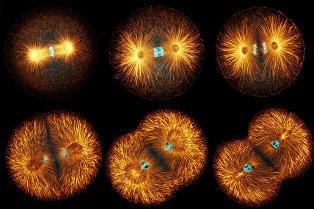


LONDON: Chromosomes play a crucial and active role rather than just a passive rule during cell division, a team of international scientist has revealed through a new research.
Published in Nature, the new research reveals that chromosomes play an active role in animal cell division and this occurs at a precise stage – cytokinesis – when the cell splits into two new daughter cells.
Cell division is fundamental to all life forms and it the mechanism through which our bodies develop from just a single cell. The initial single cell divides itself billions of times to form different types of tissues, while other continue to divide everyday to maintain the different systems in the body as well as the entire body itself.
Despite researchers having gained a fair insight into how the entire mechanism is carried out, they haven’t been able to figure out the molecular mechanisms completely, and it was believed that chromosomes play a passive role during cell division and not an active role.
Cell division is a complex process and most of the time it is performed flawlessly by the body, but when an error occurs during DNA separation or during cytokinesis there are chances that it may trigger cancer.
Cell division in animal cells involves mitosis – a process by which chromosomes are separated followed by splitting of the cell into two new daughter cells by cytokinesis.
Anyone with a little biology background will know the function of microscopic cable-like structures called microtubules – they are involved in pulling chromosomes to opposite poles of the cell during the division process.

Karachi Port sets 138-year cargo handling record
KARACHI: Pakistan's maritime sector has achieved a major milestone as Karachi Port set a new record in its 138-year history...