

Customs Today
  • Home
  • Islamabad
  • Karachi
  • Lahore
  • National
  • Transfers and Postings
  • Chambers & Associations
  • Business
No Result
View All Result
Customs Today
  • Home
  • Islamabad
  • Karachi
  • Lahore
  • National
  • Transfers and Postings
  • Chambers & Associations
  • Business
No Result
View All Result
Customs Today
No Result
View All Result
Home Science & Technology Science

New Horizons will pass closest to Pluto on 14 July

byCustoms Today Report
08/07/2015
in Science, Science & Technology
Share on FacebookShare on Twitter

You might also like

Tesla driverless system to use updated radar technology

12/09/2016

Apple to develop its own self-driving technology

10/09/2016

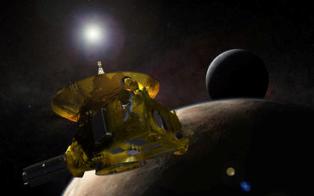
PARIS: NASA’s New Horizons spacecraft is on track to sweep past Pluto next week despite hitting a “speed bump” that temporarily halted science collection.
A computer overload prompted the spacecraft to partially shut down on July 4th—just days before the first-ever close flyby of Pluto. Flight controllers managed to regain contact with the spacecraft in just over an hour and correct the tense situation, occurring after a relatively quiet journey of 3 billion miles (4.83 billion kilometers) and 9½ years.
“We’re on to Pluto!” NASA’s director of planetary science, Jim Green, assured journalists Monday.
New Horizons will pass closest to Pluto on July 14. The spacecraft will come within 7,750 miles (12,470 billion kilometers) of the mysterious, tiny, icy world out on the fringes of the solar system.
About 2½ days of science observations were lost because of the problem. That represents about 30 observations out of 500 planned over the next week.
Principal scientist Alan Stern said it was more important to recover the spacecraft than worry about some lost observations of a Pluto still several million miles away. Data collection is expected to resume Tuesday, one week before the long-awaited flyby.
“While we prefer that this event hadn’t occurred … this is a speed bump in terms of the total return that we expect from this flyby,” said Stern, who is with the Southwest Research Institute in Boulder, Colorado. Pluto and its big moon Charon already are surprising scientists with their surface appearances, “and we’re excited to get back to that,” he added Monday.

Related Stories

Tesla driverless system to use updated radar technology

byCT Report
12/09/2016

WASHINGTON: Electric carmaker Tesla announced Sunday it was upgrading its Autopilot software to use more advanced radar technology. In a...

Apple to develop its own self-driving technology

byCT Report
10/09/2016

SAN FRANCISCO: Apple may not become an automaker, but it still wants to develop its own self-driving technology. The iPhone-maker's...

NASA spots slowest known magnetar

byCT Report
10/09/2016

WASHINGTON: Astronomers have found evidence of a magnetar - magnetised neutron star - that spins much slower than the slowest...

‘YouTubers’ outshining old-school television

byCT Report
09/08/2016

SAN FRANCISCO: A media revolution is taking place, and most people over 35 years of age aren’t tuned in. Millennial...

Next Post

Nokia N1 comes with 64-bit Intel Atom Z3580 processor clocked at 2.3GHz, coupled with 2GB of RAM

  • Terms and Conditions
  • Disclaimer

© 2011 Customs Today -World's first newspaper on customs. Customs Today.

No Result
View All Result
  • Transfers and Postings
  • Latest News
  • Karachi
  • Islamabad
  • Lahore
  • National
  • Chambers & Associations
  • Business
  • About Us

© 2011 Customs Today -World's first newspaper on customs. Customs Today.