

LONDON: A wisp of cosmic radio waves, emitted before our solar system was born, shows that a new radio telescope will be able to detect galaxies other telescopes can’t. The work, led by Dr James Allison of the Commonwealth Scientific and Industrial Research Organisation (CSIRO) in Australia, was announced today (6 July) at the National Astronomy Meeting in Llandudno, north Wales.
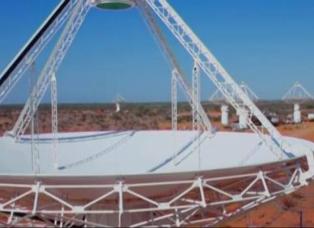
The finding was one of the first made with CSIRO’s Australian Square Kilometre Array Pathfinder (ASKAP), a new radio telescope 300 kilometres inland from the Western Australian town of Geraldton.
The discovery team, which included astronomers from the University of Sydney and the Australian Research Council’s Centre of Excellence for All-sky Astrophysics (CAASTRO), worked with just six of ASKAP’s 36 radio dishes, a subset being used to commission the telescope.
Coming from the galaxy PKS B1740-517 in the direction of the southern constellation of Ara, the radio signal had travelled through space for five billion years before being captured.
It carries the ‘imprint’ of cold hydrogen gas that it passed through on its way here. Cold hydrogen gas is the raw material for forming stars and is plentiful in most galaxies. Astronomers can spot a galaxy from its hydrogen gas even when its starlight is faint or hidden by dust.

Karachi Port sets 138-year cargo handling record
KARACHI: Pakistan's maritime sector has achieved a major milestone as Karachi Port set a new record in its 138-year history...