

Customs Today
  • Home
  • Islamabad
  • Karachi
  • Lahore
  • National
  • Transfers and Postings
  • Chambers & Associations
  • Business
No Result
View All Result
Customs Today
  • Home
  • Islamabad
  • Karachi
  • Lahore
  • National
  • Transfers and Postings
  • Chambers & Associations
  • Business
No Result
View All Result
Customs Today
No Result
View All Result
Home Science & Technology Science

New research suggests Milky Way bigger than we thought

byCustoms Today Report
16/03/2015
in Science, Science & Technology
Share on FacebookShare on Twitter

You might also like

Tesla driverless system to use updated radar technology

12/09/2016

Apple to develop its own self-driving technology

10/09/2016

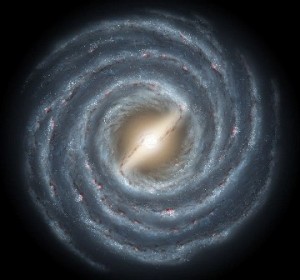
CANADA: A team of scientists led by Dr. Heidi Jo Newberg of the Rensselaer Polytechnic Institute have posited that the flat disc shape commonly attributed to our galaxy is instead a collection of concentric ripples, meaning that the Milky Way is least 50% bigger than previously thought, spanning 150,000 light-years across. The general consensus among scientists had it at 100,000 light-years.
“If there are ripples, then it looks like the number of stars in the (presumed flat) disk drops off quickly, and then farther out where the disk ripples back up it looks like a detached ring of stars appears,” Dr. Newburg told the Huffington Post. “We now understand that the galaxy didn’t end; the disk is just going up and down–in and out of our view.”
“In essence, what we found is that the disk of the Milky Way isn’t just a disk of stars in a flat plane–it’s corrugated.”
Dr. Newburg noted the corrugations are consistent with previous theoretical research that supports the idea that a dwarf galaxy or dark matter going through the Milky Way would produce the same rippling effect.
The research, funded by the National Science Foundation, was published this week in the Astrophysical Journal. Dr. Newburg and her team used the Sloan Digital Sky Survey, a collection of astronomical observations, to show the asymmetry in the main sequence star counts on each side.

Related Stories

Tesla driverless system to use updated radar technology

byCT Report
12/09/2016

WASHINGTON: Electric carmaker Tesla announced Sunday it was upgrading its Autopilot software to use more advanced radar technology. In a...

Apple to develop its own self-driving technology

byCT Report
10/09/2016

SAN FRANCISCO: Apple may not become an automaker, but it still wants to develop its own self-driving technology. The iPhone-maker's...

NASA spots slowest known magnetar

byCT Report
10/09/2016

WASHINGTON: Astronomers have found evidence of a magnetar - magnetised neutron star - that spins much slower than the slowest...

‘YouTubers’ outshining old-school television

byCT Report
09/08/2016

SAN FRANCISCO: A media revolution is taking place, and most people over 35 years of age aren’t tuned in. Millennial...

Next Post

Arctic sea winter ice near its all-time record low

  • Terms and Conditions
  • Disclaimer

© 2011 Customs Today -World's first newspaper on customs. Customs Today.

No Result
View All Result
  • Transfers and Postings
  • Latest News
  • Karachi
  • Islamabad
  • Lahore
  • National
  • Chambers & Associations
  • Business
  • About Us

© 2011 Customs Today -World's first newspaper on customs. Customs Today.