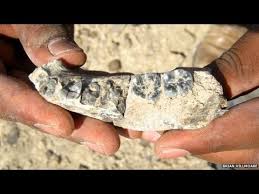


NUMIBE: A fossil find adds another twig to the human evolutionary tree, giving further evidence that the well-known “Lucy” species had company in what is now Ethiopia.
A lower jaw, plus jaw fragments and teeth, dated at 3.3m to 3.5m years old, were found in the Afar region of northern Ethiopia four years ago.
That shows a second human ancestor lived in about the same area and time frame as Lucy’s species, researchers said. But not everyone agrees.
In a paper released by the journal Nature, researchers announce the new find and assign it to a species they dubbed Australopithecus deyiremeda.
But nobody knows just how it’s related to our own branch of the family tree, said Yohannes Haile-Selassie of the Cleveland Museum of Natural History, who led the discovery team.
Our branch, which includes Homo sapiens and our closest extinct relatives, arose from the evolutionary grouping that now includes the new creature as well as Lucy’s species. The new arrival, and the possibility of still more to come, complicates the question of which species led to our branch, he said.
Previously, fossilised foot bones found in 2009 near the new discovery site had indicated the presence of a second species. But those bones were not assigned to any species, and it’s not clear whether they belong to the newly identified species either, Haile-Selassie said.
If they don’t, that would indicate yet another species from the same time and region as Lucy’s species, Australopithecus afarensis.

Karachi Port sets 138-year cargo handling record
KARACHI: Pakistan's maritime sector has achieved a major milestone as Karachi Port set a new record in its 138-year history...