
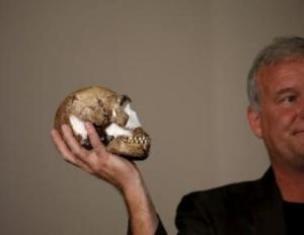


MALI: A new species of human relative, called Homo naledi, has been discovered deep in a cave in South Africa, it was announced Thursday morning at a press conference in Johannesburg. Three men who led the expedition took part gave more insights to National Geographic Society about how the fossils were found, their excavation and their two-year analysis by teams of international experts as to their place in human evolution.
For few questions posed, Lee Berger, an archaeologist and the leader of the expedition, John Hawks, an anthropologist and Paul Dirks, a geologist, gave some interesting answers. They said, “Until recently, most anthropologists believed that brain size and tool use emerged together with smaller tooth size, higher-quality diet, larger body size and long legs. In this view, transformations in the body in early Homo were tied to changes in behaviour that influenced diet and the brain. H. naledi shows that these relationships are not what anthropologists expected. It has small teeth and hands that seem to have been effective for toolmaking but also a small brain.”
To question about H. naledi if it’s very old? Or very young? and about what happened to it, the group replied, “If it turns out that H. naledi is old, say older than around 2-million-years, it would represent the earliest appearance of Homo that is based on more than just an isolated fragment. On the other hand, if it turns out that H. naledi is young, say less than 1-million-years old, it would demonstrate that several different types of ancient humans all existed at the same time in southern Africa, including an especially small-brained form like H. naledi. Given its primitive skeletal adaptations, this might have profound implications for the development of the African archaeological record.”
About the broader implications of H. naledi, they answered, “It is clear that we have missed some key transitional forms in the fossil record, as H. naledi represents an unexpected combination of australopith-like and human-like features that, until now, was entirely unknown to science. This serves to highlight our ignorance about our own genus across the span of the African continent. There are obviously many unknown fossil species yet to be discovered. In addition, we must recognise that some species of ancient humans exhibited very human-like behaviors, which in turn will have profound implications for the archaeological record.”

Karachi Port sets 138-year cargo handling record
KARACHI: Pakistan's maritime sector has achieved a major milestone as Karachi Port set a new record in its 138-year history...


