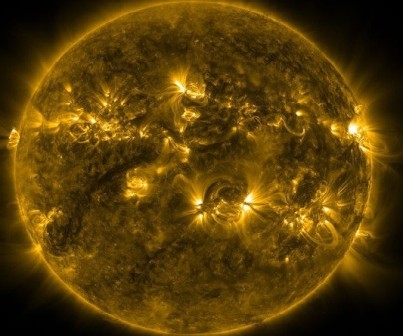


MEXICO: A new telescope has captured the first-ever detailed view of the interior structure of umbrae, the dark patches in the center of sunspots. The images reveal dynamic magnetic fields responsible for the plumes of plasma that emerge as bright dots interrupting their darkness.
The new, high-resolution images were taken through the Big Bear Solar Observatory’s (BBSO) New Solar Telescope (NST). These images reveal the atmosphere above the umbrae to be finely structured, consisting of hot plasma intermixed with cool plasma jets as wide as 100 kilometers.
“We would describe these plasma flows as oscillating cool jets piercing the hot atmosphere,” said Vasyl Yurchyshyn, one of the researchers, in a news release. “Until now, we didn’t know they existed. While we have known for a long time that sunspots oscillate-moderate resolution telescopes show us dark shadows, or penumbral waves, moving across the umbra toward the edge of a sunspot-we can now begin to understand the underlying dynamics.”
The oscillating jets, called spikes, result from the penetration of magnetic and plasma waves from the sun’s photosphere, which is the atmospheric layer of the sun that gives off light. These spikes then travel outward along magnetic tubes into the abutting chromosphere.

Karachi Port sets 138-year cargo handling record
KARACHI: Pakistan's maritime sector has achieved a major milestone as Karachi Port set a new record in its 138-year history...