

Customs Today
  • Home
  • Islamabad
  • Karachi
  • Lahore
  • National
  • Transfers and Postings
  • Chambers & Associations
  • Business
No Result
View All Result
Customs Today
  • Home
  • Islamabad
  • Karachi
  • Lahore
  • National
  • Transfers and Postings
  • Chambers & Associations
  • Business
No Result
View All Result
Customs Today
No Result
View All Result
Home Science & Technology Science

NJIT’s new solar telescope peers deep into sun to track the origins of space weather

byCustoms Today Report
29/04/2015
in Science, Science & Technology
Share on FacebookShare on Twitter

You might also like

Tesla driverless system to use updated radar technology

12/09/2016

Apple to develop its own self-driving technology

10/09/2016

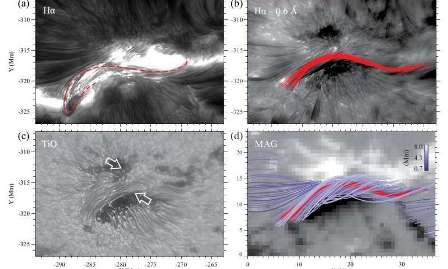
NEW YORK: Scientists at NJIT’s Big Bear Solar Observatory (BBSO) have captured the first high-resolution images of the flaring magnetic structures known as solar flux ropes at their point of origin in the Sun’s chromosphere. Their research, published in Nature Communications, provides new insights into the massive eruptions on the Sun’s surface responsible for space weather.
Flux ropes are bundles of magnetic fields that together rotate and twist around a common axis, driven by motions in the photosphere, a high-density layer of the Sun’s atmosphere below the solar corona and chromosphere. The NJIT images were taken from observations of the newly commissioned 1.6m New Solar Telescope (NST) at BBSO.
“These twisting magnetic loops have been much studied in the Sun’s corona, or outer layer, but these are the first high-resolution images of their origination in the chromosphere below it. For the first time, we can see their twisting motion in great detail and watch how it evolves,” said Haimin Wang, distinguished professor of physics at NJIT and the study’s lead author.
Wang and his co-authors strung together a series of images which trace the formation of an S-shaped bundle of magnetic fields from which a set of loops peel off and grow upward into a multi-strand flux rope within a few minutes. Two flare ribbons appear at the two sides of the rising flux rope.

Tags: Big Bear Solar ObservatoryHaimin WangNJIT’s new solar telescope

Related Stories

Tesla driverless system to use updated radar technology

byCT Report
12/09/2016

WASHINGTON: Electric carmaker Tesla announced Sunday it was upgrading its Autopilot software to use more advanced radar technology. In a...

Apple to develop its own self-driving technology

byCT Report
10/09/2016

SAN FRANCISCO: Apple may not become an automaker, but it still wants to develop its own self-driving technology. The iPhone-maker's...

NASA spots slowest known magnetar

byCT Report
10/09/2016

WASHINGTON: Astronomers have found evidence of a magnetar - magnetised neutron star - that spins much slower than the slowest...

‘YouTubers’ outshining old-school television

byCT Report
09/08/2016

SAN FRANCISCO: A media revolution is taking place, and most people over 35 years of age aren’t tuned in. Millennial...

Next Post

Spain's economy expands by 1.4 percent in 2014

  • Terms and Conditions
  • Disclaimer

© 2011 Customs Today -World's first newspaper on customs. Customs Today.

No Result
View All Result
  • Transfers and Postings
  • Latest News
  • Karachi
  • Islamabad
  • Lahore
  • National
  • Chambers & Associations
  • Business
  • About Us

© 2011 Customs Today -World's first newspaper on customs. Customs Today.