Think of coconut, and what comes to mind? Perhaps dried coconut, used in desserts like macaroons, or cans of creamy coconut milk, a perfect addition to spicy curries. If you’ve traveled to a tropical country, maybe you think of fresh green coconuts, the ultimate in refreshing beverages.
But there’s so much more that coconut can do, as I’ve learned while traveling in Sri Lanka. In fact, for many rural-dwelling families here, the coconut palm is a provider of numerous products. I got a crash course in coconut customs from Ajith Kapurubandara, guide for the Intrepid Travel tour that I have joined for two weeks.


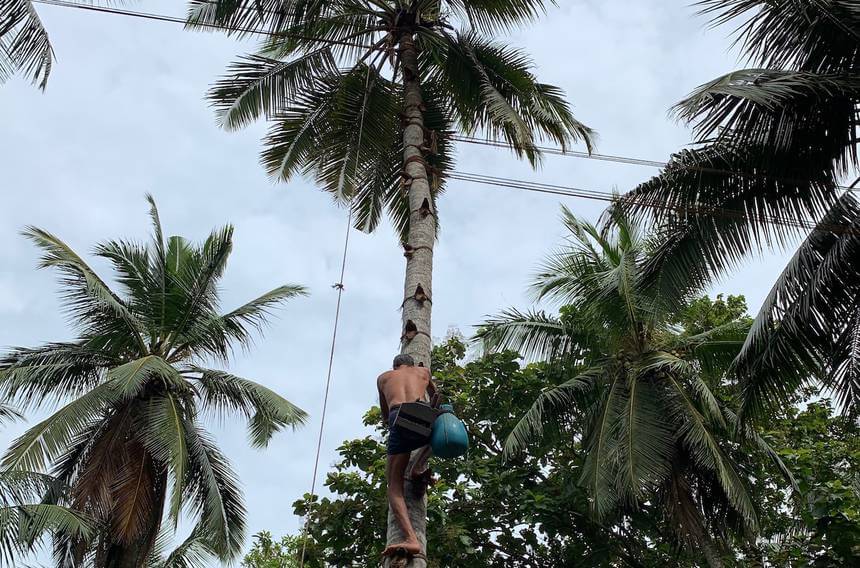
Just outside of Negombo, Ajith took us to a private residence with several towering coconut palms lining the edge of a well-swept, packed dirt yard. He introduced us to the man who lives there, Rohana, who has been scaling coconut palms since childhood.
The palms, Ajith explained, live for 80 years, but they provide for their owners throughout (and even after) their life. For example, the leaves are large and fan-like, with a stiff fiber running down the center. That fiber is taken out and used to make brooms and rugs for homes. When the leaves are soaked in water for several weeks, they become soft and can be woven to make a natural roof material. The bark is also useful for roof-building, as it contains plenty of fiber, making it hard for insects to attack as long as it’s kept dry.
Coconut shells have long been used for cups and bowls, although less commonly now; and when the palm tree eventually dies, its trunk is used as firewood. Whatever is left gets burned, and then banana farmers gather the ash to spread around their plants as fertilizer.
Then there are the crops produced by the coconut palm. Most familiar is the coconut fruit, which grows from a flower. It takes a full year for one coconut to reach harvest, and each flower produces 20-25 coconuts. New flowers bloom every three months, which means that a coconut palm farmer has a fairly regular crop to harvest. That process is a dangerous one, as it requires either climbing the tree or using a long bamboo stick with a blade to cut them down.