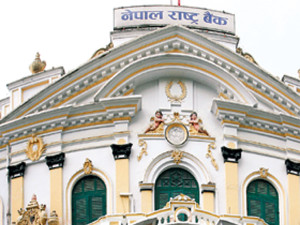
KATHMANDU: The banking sector will have to wait for some more time to reap benefit from the remodelled interest rate corridor, as the Nepal Rastra Bank (NRB), the central bank, is still in the process of preparing the guideline to implement the refurbished system. Earlier, the NRB had said a “matrix” to operate the corridor had been approved and a guideline would be introduced within mid-August. But it could introduce the guideline within that period, as it decided to conduct review of operation modalities of interest rate corridors in other countries. “We are still conducting these studies,” said a high-ranking NRB official with knowledge of the matter. “So, it will take some more time to finalise the guideline.” The main objective of the new interest rate corridor is to keep all interest rates in the banking system within a band of 3 percent to 7 percent in the fiscal year 2017-18, which began on July 16.
Relatively higher interest rates, the NRB deems, will benefit depositors, who will get better returns, and discourage borrowing for speculative purpose, which unnecessarily raises prices of assets, such as real estate and stocks. But lately short term money market rates have fallen below 1 percent mark due to excess liquidity. This may prompt all the interest rates to take a dip as in the first quarter of the last fiscal year. Such a scenario will hit depositors and encourage borrowers to channel funds towards unproductive sectors. This is the reason why some of the bankers have been calling on the NRB to expedite the process of bringing the interest rate corridor into operation.


The NRB had first introduced the corridor in the last fiscal year to guide short-term market rates and keep all interest rates within a certain range to reduce interest rate volatility. Stability in interest rates provides clear signal to bankers, policymakers, borrowers and depositors on movement of interest rates, raising predictability. However, following introduction of the corridor in the last fiscal year, interest rates had fluctuated wildly with average interbank lending rates shooting up to as high as 7 percent and plunging to less than 0.5 percent. This happened because the NRB, at that time, had used average interbank lending rate of commercial banks as reference to fix reverse repo or floor rate. This practice has now been abolished and a fixed interest rate has been introduced to reduce interest rate volatility. The interest rate corridor basically operates using three different rates. First is the standing liquidity facility (SLF) rate. This is the rate at which the NRB injects liquidity into the banking sector whenever there is shortage of funds. This rate has been fixed at 7 per cent; and it forms the upper bound, or ceiling, of the corridor.
Second rate used in the corridor is the repo, or policy, rate. This is the rate at which liquidity is injected into the market for a period of two weeks. This rate floats in the middle of the corridor. Until last fiscal year, this rate was fixed by adding 200 basis points, or 2 percentage points, to weighted average interbank rate of commercial banks. The latest Monetary Policy has fixed this rate at 5 percent. The third rate used in the corridor is the two-week term deposit rate. This rate forms the lower bound, or floor, of the corridor. Until last fiscal year, this rate was fixed by deducting 10 basis points, or 0.10 percentage point, from weighted average interbank rate of commercial banks. The latest Monetary Policy has fixed this rate at 3 percent. These three rates fixed by the NRB, according to central bank officials, will enable all interest rates to move within the band of 3 percent and 7 percent in the fiscal year 2017-18.