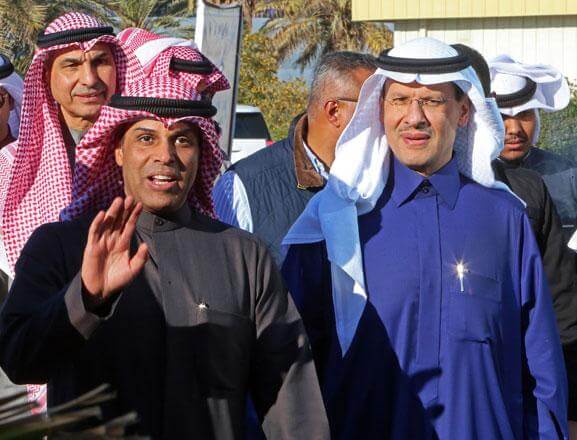
KUWAIT: The Kuwaiti and Iraqi oil ministers said yesterday that OPEC will not cut production unless producers outside the cartel do the same, despite the plunge in crude prices. “OPEC cannot cut its production unless there is a similar reduction by producers outside OPEC,” Kuwait’s acting oil minister Anas Al-Saleh, told reporters on the sidelines of an oil conference. “I don’t see any logic in OPEC cutting production while non-OPEC (countries) don’t cut,” Saleh said.
Iraqi Oil Minister Adel Abdulmahdi said Baghdad was “ready to cooperate” on cutting production to raise oil prices, but only if non-OPEC producers did so as well. The Organization of the Petroleum Exporting Countries has refused to cut production despite a drop in oil prices to 13-year lows. Led by Gulf producers, the cartel is refusing to reduce crude output as it seeks to drive less competitive players, including US shale producers, out of the market. Oil prices rose above $30 a barrel yesterday after a brief dip as the market was beset with worries about the global supply glut.
Abdulmahdi and Saleh said they were willing to back an emergency meeting of OPEC, but only if an agenda were agreed in advance. “It is useless to go to a meeting without deciding up front. We said yes if others are willing to go but we have to decide before, otherwise this will backfire on us. We have to go forward – I think the market needs that but we also look at our partners outside OPEC to do the same,” Mahdi said.
The Iraqi minister told the Energy Strategy Forum that at the current crude price, the majority of producers are selling oil at lower than the cost price. He warned that if the energy crisis continues for a long time, prices could rebound strongly. “If the energy crisis continues for a long period and investments drop, the price rebound will be sudden and strong,” Abdulmahdi said. “The problem will become that of demand rather than oversupply.” The minister said that the price of oil is expected to rise gradually to around $50 a barrel in the second half of this year.
Nizar Al-Adsani, CEO of national oil firm Kuwait Petroleum Corp, said investment in global exploration and production dropped 20 percent in 2015 from $850 billion the previous year. It is projected to drop 18 percent more this year, Adsani said. He said KPC is expected to invest up to $100 billion over the coming five years to achieve the strategic directions of the oil sector until 2030.
“We anticipate an expenditure of 100 billion dollars over the next five years to achieve this target, half of which is already committed to specific identified projects,” Adsani told the conference. He noted that “low oil prices have been a prominent feature of the market since the second half of 2014, and could stay lower for longer; posing challenge to our industry, but providing an opportunity to structural reforms, to achieve long-term benefits for countries.”
He pointed to forecasts that global exploration and production (upstream) spending would fall from about $850 billion in 2014, by more than 20 percent, in 2015, while the level in 2014 over 2013 had increased by 3 percent. It will take time, probably two years for these changes to have an effect on future supplies. Global upstream spending is expected to decline by 18 percent in 2016. This would be the first time since 1986 that consecutive declines in spending were recorded, Adsani said.
It is a common sense that mature producing fields globally have an average decline rate of around 5 percent, while world oil demand will continue to expand at a range of 1-1.5 million barrels per day annually, which means that the world markets would need some 5-6 million barrels per day of new crude annually, the CEO noted. This shows the importance of continuity of investments in the upstream globally for the sake of stable markets, and to avoid volatility as well as spikes in oil prices.
Producers of crude oil have financial surpluses and tend to redistribute income via investment. The scale of the global effect is significant, Adsani said. That boost is then amplified if it generates a subsequent lift in confidence, encouraging companies to invest and spend. “We, at Kuwait Petroleum Corporation recognize that it is also a great risk if we do not make investments,” he stated