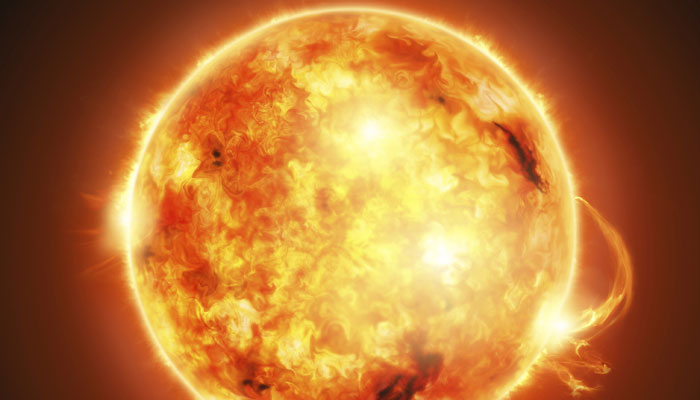

CANADA: A new study has revealed that our sun will not explode as a powerful supernova when it eventually runs out of fuel, but there will be fireworks.
Lead researcher Jose Francisco Gomez, of the Institute of Astrophysics of Andalusia (IAA-CSIC) said that in a few thousand million years, the sun will exhaust its nuclear fuel, expand into a red giant and eject a major part of its mass, eventually stripping its self bare, creating a vast planetary nebula with a small yet dense white dwarf in its core.
Until now, this progression from dying star to nebula has been assumed to be a slow and fairly ‘gentle’ process, when compared with the sheer violence of a massive star’s supernova at least, but the new study, however, suggests that the death of low to intermediate mass stars (like the sun) is anything but subdued.
Gomez added that even though every star with a mass below ten solar masses goes through this short but important final transition, many details of the process still evade us.
Researchers focused on IRAS 15103-5754, an object that is currently transitioning from a red giant into a planetary nebula. Nicknamed “water fountains,” objects like IRAS 15103-5754 generate powerful emissions produced by water vapor molecules (known as water maser emission). Jets of ejected material can therefore be detected and their outflow speeds measured.
Researcher Luis F. Miranda said that water molecules are generally destroyed soon after the planetary nebula is formed, and in the rare cases where a maser emission has been detected, the velocity has always been very low. In IRAS 15103-5754 they are seeing for the first time a water maser emission at velocities of hundreds of kilometers (miles) per second and they are witnessing the transition of a star into a planetary nebula in real time.

Tesla driverless system to use updated radar technology
WASHINGTON: Electric carmaker Tesla announced Sunday it was upgrading its Autopilot software to use more advanced radar technology. In a...