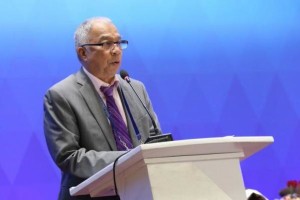
MANILA: After serving twice as head of the Bureau of Customs (BOC), outgoing Commissioner Alberto Lina bared that he is now interested in managing Metro Manila traffic.
Lina said yesterday that if his services are still needed in government, his expertise in logistics could be useful as a traffic czar or as head of the Metropolitan Manila Development Authority (MMDA).


Lina first became BOC chief from February to July of 2005 during the term of former president Gloria Macapagal-Arroyo, and he was again appointed by President Aquino to the post from April 23, 2015 until June 30 this year.
When asked if he would want to be the next MMDA chief, he said, “I will because in my heart I want to help this country.”
He said that he has not formally applied to president-elect Rodrigo Duterte.
Being in the logistics business for 42 years that started when he was just an employee and now owner of six companies under the Lina Group, the Customs chief said that he is capable of fixing the traffic chaos in the streets of Metro Manila.
He also said that in order to improve the flow of traffic, it was necessary that Duterte be given emergency powers.
If he would be appointed as traffic czar, Lina said he would lift the number coding scheme since it only prompted some people to buy more cars.
He added that there was a need to have better mass transit systems and rationalize the deployment of buses.
“We have to fix the routes of the buses and conduct a policy enhanced route measured capacity” wherein there would be a study on the movement of the riding public. By doing so, Lina said they would be able to know how many buses are needed to transport passengers at a given time of the day.
“They said that people buy cars because there are no good buses, no convenient bus system unlike in the United States where a bus arrives every 30 minutes. There has to be a study. There has to be an alternative,” he said.
They would also be helping the people reduce their transportation cost. “Government must see to it that the payment for transport would not exceed 10 percent of his or her salary. So that they would be able to use their money for other expenses such as the house, clothing, etc,” Lina added.
As for passenger jeepneys, he believes that these should be phased out and be replaced by ones that have seats and higher ceilings that would allow them to maximize space since more passengers could stand in the center aisle.
Lina also proposed the change of work schedules to decongest the riding public. Government employees should report for work from 7 a.m. until 4 p.m., while those in the private sector should open their offices at 9 a.m. until 6 p.m.
“By doing so, the buses would have more trips, it would lessen traffic congestion and lower the cost of transport,” he added.