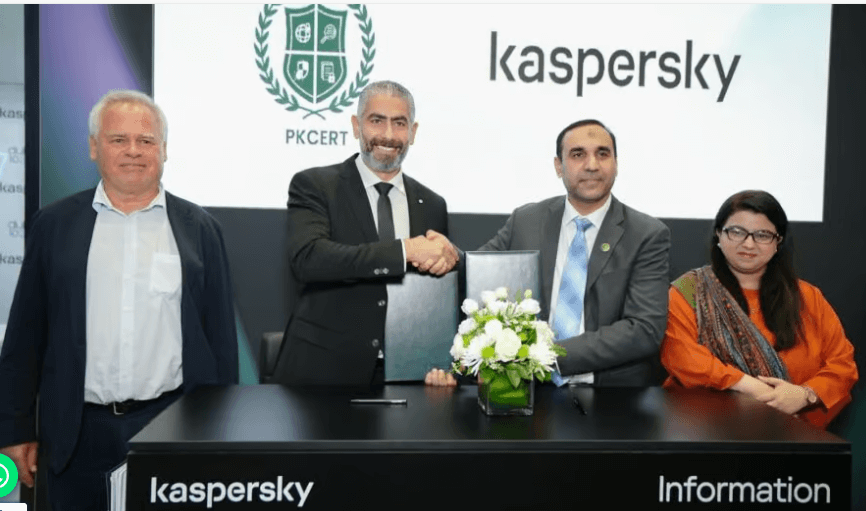
KARACHI: The National Computer Emergency Response Team of Pakistan (PKCERT) has joined hands with Kaspersky to enhance Pakistan’s national cybersecurity posture through collaboration in threat detection, mitigation, and prevention.
Both sides formally signed a Memorandum of Understanding (MoU) on Monday that focuses on strengthening the country’s cyber resilience through a series of coordinated efforts.


The MoU was signed by Dr Haider Abbas, TI, Director General, National CERT, Government of Pakistan, and Rashed Al Momani, General Manager for the Middle East and Pakistan at Kaspersky, in the presence of Eugene Kaspersky, CEO of Kaspersky, and Ms Shaza Fatima Khawaja, Federal IT Minister, Government of Pakistan.
These include extensive training and awareness programs designed to enhance operational readiness across all levels of government, industry, academia, and civil society. The collaboration also focuses on capacity development to cultivate a skilled cybersecurity workforce aligned with both national and international standards.
Additionally, the two organisations will ensure the timely dissemination of actionable cyber threat intelligence to relevant stakeholders across Pakistan.
Under the MoU, PKCERT and Kaspersky will cooperate across a wide range of cybersecurity areas, including legislative and regulatory issues, incident detection and response, prevention and mitigation strategies, cybersecurity education, research and development, and professional exchanges. The two organisations will exchange relevant technical information, threat intelligence, and data feeds related to cyber threats and cyberattacks affecting citizens, businesses, and government institutions in Pakistan.
“Information and Communication Technologies (ICTs) play a vital role in the socio-economic development of a country; however, they have also introduced new challenges such as cyber espionage, hacktivism, ransomware, data breaches, identity theft, attacks on critical infrastructure, financial and supply chain disruptions, and disinformation campaigns. Our collaboration with Kaspersky, a global leader with expertise in these domains, represents another important step toward strengthening national cybersecurity,” said Dr Haider Abbas.
“Safeguarding digital development requires robust cybersecurity, founded on deep and continuous partnerships between public authorities and private companies. Kaspersky has a long and fruitful history of working with global and regional organisations such as INTERPOL and AFRIPOL, as well as local computer emergency response teams around the world. We highly value this cooperation with PKCERT as an important step in consolidating Pakistan’s secure digital transformation for the entire nation,” commented Rashed Al Momani.