LAHORE: The Government of Pakistan has reiterated its commitment to strengthening women empowerment and expanding microenterprise development as key drivers of sustainable economic growth and export competitiveness.
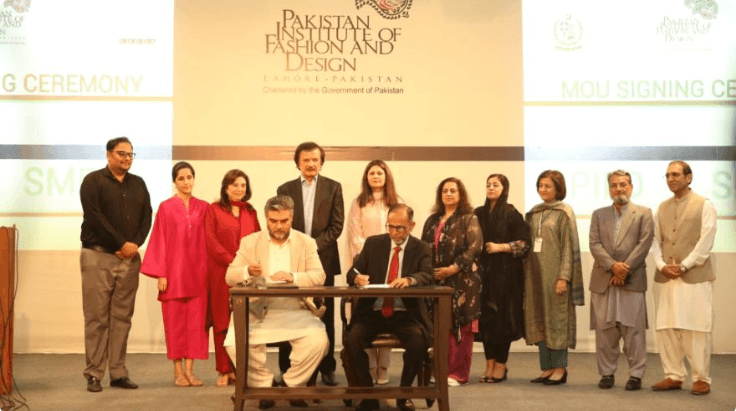
This was stated by Special Assistant to the Prime Minister (SAPM) for Industries and Production, Haroon Akhtar Khan, while addressing the Memorandum of Understanding (MoU) signing ceremony between the Small and Medium Enterprises Development Authority (SMEDA) and the Pakistan Institute of Fashion and Design (PIFD), held at PIFD Lahore.


The ceremony was attended by senior officials including Aasia Saail Khan, Member SMEDA Board, and Ms Nadia Jahangir Seth, Chief Executive Officer SMEDA, along with representatives from SMEDA, PIFD, and other stakeholders.
Earlier, the MoU was formally signed by Sheharyar Tahir, General Manager Gender and Sustainability Division of SMEDA, and Registrar PIFD Dr Muhammad Afzal, marking the start of an institutional framework aimed at closer collaboration between enterprise development and design innovation sectors.
Focus on economic inclusion
In his keynote address, SAPM Haroon Akhtar Khan underscored that women-led enterprises and micro businesses remain among the country’s most valuable yet underutilised economic assets.
“This MoU is not merely an institutional collaboration but a strategic national intervention aimed at unlocking the economic potential of women entrepreneurs and micro-businesses. By integrating SMEDA’s enterprise development expertise with PIFD’s design and innovation capabilities, we are creating opportunities for enterprises to become market-ready, financially viable, and globally competitive,” he stated.
He further emphasised that the initiative is aligned with the Prime Minister’s broader vision of inclusive economic development, innovation promotion, and job creation across Pakistan, particularly in underserved enterprise segments.
Framework for growth
The agreement establishes a structured collaboration between SMEDA and PIFD focused on supporting micro and small enterprises, with a particular emphasis on women entrepreneurs, home-based workers, and artisans.
The partnership is designed to enhance product development capacity, strengthen entrepreneurship pathways, and improve value-chain integration, while also expanding access to both domestic and international markets.
Under the framework, both institutions will explore the establishment of incubation centres, design laboratories, and creative workspaces aimed at fostering innovation, skill development, and enterprise scaling.
Key components of the collaboration include capacity building programmes, digital enablement initiatives, e-commerce integration, research collaboration, and stronger industry-academia linkages intended to support sustainable business growth.
Institutional commitment
Speaking on the occasion, Nadia Jahangir Seth, CEO SMEDA, reaffirmed the organisation’s commitment to supporting underserved enterprise categories through structured interventions.
“At SMEDA, we believe that empowering women and microenterprises is essential for inclusive economic progress. This collaboration with PIFD will provide structured design support, business development services, and improved market access, enabling enterprises to enhance product quality and competitiveness,” she remarked.
She further announced that both institutions will jointly implement a three-year national product development support programme specifically targeting women and microenterprises, focusing on strengthening design, branding and market readiness.
Academic and industry linkages
Prof. Hina Tayyaba Khalil, Vice Chancellor of PIFD, welcomed the agreement, describing it as a significant step in enhancing the role of academia in national economic development.
“PIFD is proud to partner with SMEDA to bring design innovation, research, and creativity into the enterprise sector. This collaboration will create meaningful linkages between students, designers, and entrepreneurs, while enhancing the value and competitiveness of locally produced goods,” she stated.
She highlighted that the partnership would also provide practical exposure to students while directly contributing to enterprise-level innovation and product development.
The ceremony included a detailed presentation on the PIFD Design and E-Commerce Centre, followed by an interactive question-and-answer session involving participants from both institutions.
A formal exchange of souvenirs was held after the signing ceremony, along with a guided visit to the design and innovation facilities at PIFD Lahore. The programme concluded with a press interaction and group photograph involving all stakeholders.
The initiative is expected to support improvements in product quality, production efficiency, digital participation, financial inclusion, and broader market access for micro and women-led enterprises, while contributing to ongoing efforts aimed at strengthening Pakistan’s inclusive economic landscape.