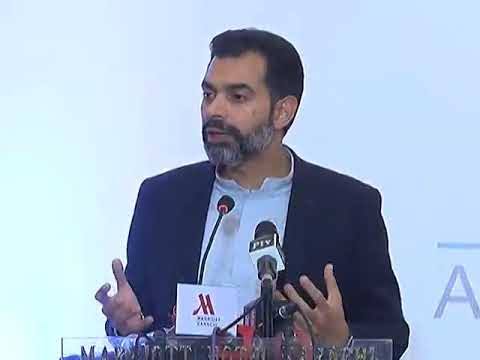
KARACHI: The State Bank of Pakistan (SBP) governor is quite hopeful that the latest International Monetary Fund (IMF) loan programme will be the last one and Pakistan will not need to go back to the lender in future.
He was delivering a lecture at International Business Administration (IBA) University on “Pakistan Economy: Macroeconomic Challenges and Outlook”.

Talking about the economic outlook, he questioned whether “this will be the last IMF programme” and explained, “how Pakistan should not go back to the IMF after this programme.” Baqir said maintaining high reserves remained the most crucial challenge to the economy to get rid of the IMF in the future. The reforms introduced to determine the rupee-dollar exchange rate would help in maintaining the reserves at an optimal level, he added.
“Yes, we entrenched a market-based exchange rate system, which means the rate will be determined by the supply and demand (of dollars in the market)… which is perhaps one of the key institutional changes that have happened in the reform process,” he said.
Earlier, the central bank had control over the rupee-dollar exchange rate. It used to fix the rate but the practice caused depletion in the country’s foreign currency reserves almost every time after Islamabad completed the IMF loan programme since 1995. This forced Pakistan to return to the Fund time and again, he said. The central bank still has the option to intervene in the market to control exchange rate in case it finds market participants are involved in manipulating the market-based exchange rate.
He said the massive rupee devaluation of around 52% since December 2017 to Rs160.05 to the US dollar on June 30, 2019, had started reviving exports, mainly in volumetric terms. “The competition authority in the country needs to play its role to encourage local firms to become competitive at the global level in order to further increase the exports,” he said.
The demand and supply-based rupee-dollar exchange system have also helped in improving foreign currency reserves and helped the rupee recover 2.43% to Rs156.17 on Friday (September 27) compared to Rs160.05 on June 30.
The new system, among other measures, also caused a meaningful reduction in the current account deficit to around $650 million a month in the first two months (July-August) of the current fiscal year 2019-20 compared to $2 billion a month in FY18 and around $1 billion a month in FY19.
The end of volatility and return of stability to the exchange rate also invited renewed portfolio investment in debt and stock markets in the first two months of FY20, the SBP governor noted. The significant adjustment in the rupee against the dollar in the past two years, however, caused high inflation in the economy. The situation prompted the monetary policy committee of the central bank to increase the key interest rate to counter inflationary pressure.
The SBP committee increased the policy rate by 7.5% in a series of monetary policy statements since January 2018 to an eight-year high at 13.25%.
Baqir highlighted three key elements for running the economy independently, going forward. He talked extensively about having sufficiently high foreign currency reserves among the three to permanently quit the IMF.
“Whether this programme will be different from others is to answer the question of whether the reserves’ accumulation…will be the one that remains firmer,” he said.
The two other elements to avoid the IMF included maintaining the “fiscal discipline” through zero government borrowing from the central bank and raising domestic saving and investment rates. Government borrowing from the central bank causes inflation. The latest 39-month-long IMF loan programme formally started in July, when the lender released the first tranche of $991.4 million (SDR 716 million) of the total loan programme of $6 billion.
Baqir, who resigned from the IMF and joined the State Bank in May, once again reiterated that the country opted for the best available option by going back to the IMF in the recent past with the objective of improving its capacity to make international payments mainly in two areas – imports and debt repayment.