

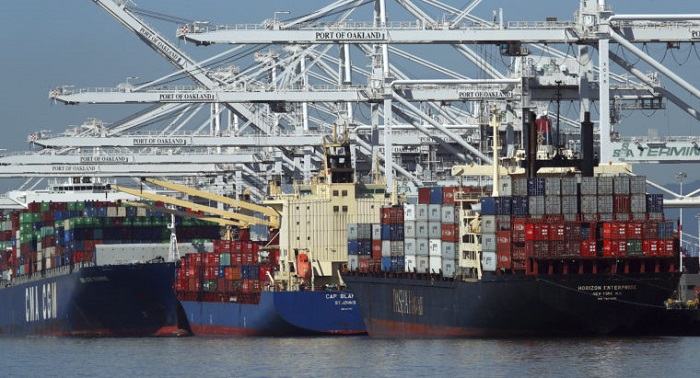
NEW YORK: The canal across the Isthmus of Panama in Central America is about to be enlarged, or more accurately, a new wider and deeper channel is about to be added to the two existing channels, which will continue operations. Ships more than 48 meters wide and 15 meters deep will be able to traverse Panama, compared with the previous 32 meters and nearly 12 meters. Recall basic physics: volume rises by the cube of the linear dimension. This means that ships carrying 13,000 container boxes will be able to use the canal, up from a maximum of around 5,000 containers today.
This new canal will have major implications for China’s trade, since exports will be able to reach ports in both eastern North and South America entirely by sea, more cheaply if the Panama’s canal tolls allow, but in any case in higher volume since the existing canal operates at maximum capacity during much of the year. And West Coast ports, from which Chinese goods move east by rail, are also often congested.

Because of delays, opening the new canal, which cost US$ 6.8 billion, will not quite be in time for the centenary of the existing canal, which opened in 1914. That was a huge engineering achievement, since the route from the Pacific Ocean to the Atlantic Ocean (via the Caribbean Sea) had to cut through a range of small mountains and a lake had to be created. Some 205 million cubic meters of rock and dirt had to be removed. Six locks, three in each channel, were built to raise ships over 25 meters, then six more to lower them on the other side. The original canal took 10 years to construct – at a cost of US$ 330 million for the 1914 canal, roughly US$ 5.9 billion in today’s dollars – and cost over 5,600 lives. This compares with only six lives lost during work on the new canal, even though an additional 155 cubic meters of material had to be moved, thanks to heavy machinery, physical work has become faster, easier and much safer.
Because of the curvature of Panama, the canal is angled such that ships entering the Pacific side travel north and west to enter the Caribbean side, i.e. the sun at the canal rises over the Pacific and sets over the Atlantic!
The Panama Canal resulted in a major improvement in transport to East Asia from the U.S. East Coast and from Gulf of Mexico ports drawing on the entire basin of the Mississippi River. Before the canal, trans-shipment across Panama – off-loading on one side and reloading on the other – took place by mule or, after 1855, by rail. Or else ships had to sail by the long and challenging route around South America. This latter route involved the famous clipper ships, magnificent three-masted sailing vessels made for speed; American furs, ginseng, light manufactures and even ice exchanged for tea, silk and fine porcelain (called “china”) from China. The voyage from New York to Canton (Guangzhou) took an uncertain four months. Now the trip can be made with steamships through the Panama Canal in three weeks.
The era of the clipper ship was curtailed by the opening of the Suez Canal in 1869, greatly shortening the distance between Britain and India and China, and by completion of a railroad to San Francisco in the same year, greatly cutting the travel time between China and New York. The advent of steamships, clumsy at first but constantly improving, spelled their eventual doom.
Ferdinand de Lesseps, the French engineer who built the Suez Canal, also attempted the shorter but much more challenging one across Panama, but was defeated, mainly by debilitating and fatal tropical diseases, especially yellow fever. Success hinged on learning that this and other diseases were transmitted by mosquitos and keeping the insects under control. This discovery by an American army doctor permitted work to begin again in 1904, this time by the United States, led by its president, Theodore Roosevelt. Work on the Canal was organized and financed by the U.S. government on the condition that shipping tolls through the finished canal would only cover operating and maintenance expenses, precluding the collection of rents or profits beyond a small annual payment to Panama – an early example of provision by the United States of an international public good, to be followed by many later examples, such as basic medical research and the geo-positioning satellite system, perhaps providing a precedent for China’s New Silk Road. (Per capita GDP in China is higher today than it was in the United States in 1913.) Canal ownership was passed partially to Panama by the U.S. government in 1979 and completely in 1999. Panama raised the tolls, not only to cover increased operating expenses, but also to provide significant revenue for the government.
Even the enlarged canal will not allow passage to the largest ships, such as bulk carriers for iron ore, grain or oil, which are too large and too deep in their draft. From Argentina (soybeans), Brazil (soybeans and iron ore) and the east coast of Venezuela (oil) they reach China via southern Africa and the Indian Ocean, a very long distance, although some bulk carriers can travel through the enlarged Suez Canal. There is talk of building a new, even larger canal through Nicaragua, long seen as an alternative to Panama for an Atlantic to Pacific canal. Work on it has allegedly started, financed by a Chinese entrepreneur, but without explicit support by China’s government. Alternative short-cuts would be the Northwest Passage through Canada or route over Russia, as Arctic ice recedes. Or the building of more railroads in South America – from Brazil over the formidable Andes mountains in Peru to the Pacific, and/or from the Atlantic to the Pacific coast of Colombia – in both of which China has expressed an interest.


