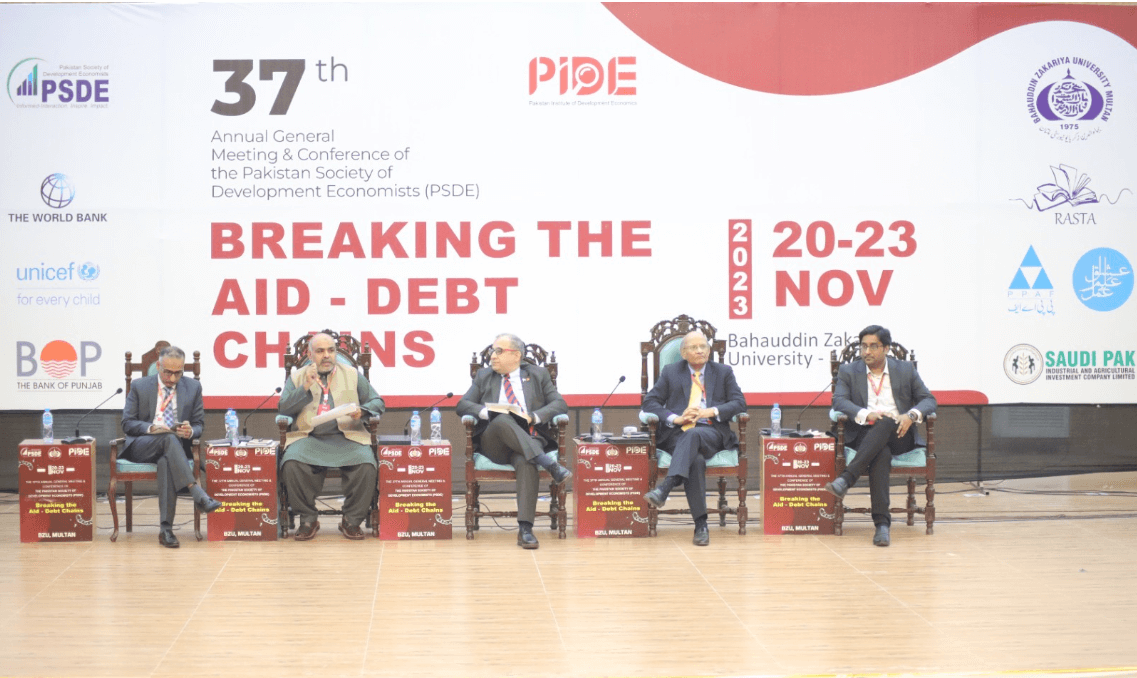
ISLAMABAD: The economic experts participating in panel discussions on Wednesday highlighted different aspects of the country’s existing taxation and public debt management policies and recommended corrective measures to strengthen the national economy on a sustainable basis.
The discussion was held on different topics titled “Is Taxing More the Only Solution?” – “Evaluating Pakistan’s Public Debt Management Policies and Practices” – “Growing Pakistan: FDI, Domestic Investment and Foreign Aid”- “Aid and Development in South Punjab”, and “Understanding the Economy of South Punjab,” a news release said here.

It was 2nd round of a three-day Annual General Meeting (AGM) and conference of the Pakistan Society of Development Economists (PSDE) on the theme “Breaking the Aid–Debt Chains”, organized by the Pakistan Institute of Development Economics (PIDE) in collaboration with Bahaduddin Zakariya University (BZU) at the latter’s Jinnah Auditorium in Multan.
The panel discussion on “Is Taxing More the Only Solution?” was moderated by Mahmood Khalid, Senior Research Economist at PIDE and participated by panelists FBR Member Customs, Legal and Accounting Mukaram Jah Ansari, former Member at the Planning Commission Asim Saeed, NDU Professor Abdul Jalil and PIDE Senior Research Economist Omer Siddique.
Dr Mahmood Khalid said the current focus on taxing more ignored the burden it imposed, adding ”Our complex tax system and regulatory landscape contribute to a high regulatory burden. Pakistan ranks low in ease of paying taxes, discouraging firms from growth and formalization. PIDE’s approach suggests improving the system first before considering additional taxation.”
Mukarram Ansari explained Pakistan’s fiscal model, highlighting an annually rising tax collection target given to the Federal Board of Revenue (FBR).
“Two-thirds of the collection is from customs and withholding agents. Taxing at the import stage, however, hampers businesses due to restricted cash flow.”
Abdul Jalil criticized Pakistan’s projection as a nation of tax evaders, emphasizing the need to build a narrative of growth. He stressed that tax collection does not cause growth, citing China and India’s examples of promoting growth first. Omer Siddique posed the question of whether taxing is a panacea for our ills.
He said that even though taxes created distortions and disincentivized economic activity but were essential. He highlighted PIDE’s research on the heavy taxation burden on the retail sector.
For charting a way forward, the FBR Member Customs recommended fixing how FBR worked, separating the regulator from the tax collector.
“Tax policy should focus on promoting growth and investment, not just meeting revenue targets,” he said urging the digitization of the FBR and provincial taxing authorities and redressal of Human Resource issues.
Asim Saeed felt there was a need for a short-term focus on cutting expenditures, reviewing subsidies, and taxing untaxed sectors of the economy.
He called for bringing down interest rates and avoiding ad hocism in taxing windfall gains.
Abdul Jalil advocated encouraging transactions and taxing once the economy was moving, aligning with Adam Smith’s suggestion, while Omer Siddique urged moving away from anomalies and ad hocism that harmed the economy.
PIDE Vice-Chancellor Dr Nadeem ul Haque expressed concern that “we are already taxing ourselves too much and criticized economists for not making a case for investment and growth beyond advocating for more taxes.” Dr Ashfaque H. Khan stressed the role of interest payments in harnessing the deficit.
In another panel discussion “Evaluating Pakistan’s Public Debt Management Policies and Practices” were discussed, which was moderated by PIDE Associate Professor Nasir Iqbal, Muhammad Arshad of the Ministry of Commerce, and Nofal Daud, Head Strategy and Strategic Initiatives at the Bank of Punjab.
Haider Ali, Assistant Professor at PIDE, initiated the discussion by highlighting the alarming rise in Pakistan’s debt-to-GDP ratio with the potential for further increase.
He identified fiscal imbalances, a high exchange rate, and neglect of various borrowing instruments as contributing factors.
Muhammad Arshad shed light on the absence of a formal policy on debt management in Pakistan. He emphasized the fragmented nature of institutions handling debt, with poor coordination among them.
Dr Ashfaque H. Khan emphasized the need for a debt office and law to ensure fiscal prudence.
While commenting on the discussion, Dr Nadeem ul Haque questioned the lack of return on debt servicing and criticized the quarters concerned for its vague approach and lack of knowledge about the destination and cost of debts.
Economic experts also discussed “Growing Pakistan: FDI, Domestic Investment and Foreign Aid,” “Aid and Development in South Punjab”, and “Understanding the Economy of South Punjab.”
The day concluded with the book talk on “Sovereign Debt: A Guide for Economists and Practitioners,” written by Syed Ali Abbas of the IMF. The book talk was moderated by PIDE Vice-Chancellor Dr Nadeem Ul Haque.
The co-hosts of PSDE’s 37th Annual Conference, organized by PIDE, include the World Bank Group, UNICEF, RASTA, the Bank of Punjab, Pakistan Poverty Alleviation Fund, Saudi Pak Agricultural and Industrial Investment Company, and BZU School of Economics.