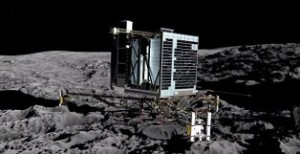


MEXICO: A new video captures the moment Philae, Europe’s now-famous comet lander, first approached Comet 67P for its historic landing on 12 November last year.
Philae acquired a series of still images with its Rolis descent camera.
These pictures of the dusty, icy terrain were spaced 10 seconds apart, tracking the little probe’s descent from a height of 67m down to just 9m.
Now, with the aid of visual effects, the Rolis sequence has been turned into a flowing, one-minute movie.
It is run in real-time, thus giving a good sense of what it would have been like to ride down to the comet’s surface with Philae.
The European Space Agency (Esa) has released the movie to mark the one-year anniversary of the selection of the landing site, which was on the “head” of the duck-shaped comet.
Of course, as everyone now knows, Philae did not stay at this location – dubbed Agilkia – for very long.
After touching the surface, the lander immediately bounced away, travelling high over the comet for more than a kilometre, before finally coming to rest in a dark ditch.
Its whereabouts (this location has been called Abydos) is not known precisely, but scientists have a good hunch about where it is likely to be, to within a few metres.
This has not helped much, however, with their attempts to re-establish regular communications between Philae and its “mothership” Rosetta, which is still orbiting the comet.
After working for 60 hours following the landing on 12 November, the probe fell silent, unable to recharge its battery in its shadowed surroundings.
When lighting conditions improved with the change in seasons earlier this year, seven contacts with Philae were made. But these links were all too brief to restart any science observations on the surface of 67P.
Esa hopes to have better luck later in the year when Rosetta is able to move in close to the comet again. Currently, the relay satellite is standing off at a distance of several hundred km.

Karachi Port sets 138-year cargo handling record
KARACHI: Pakistan's maritime sector has achieved a major milestone as Karachi Port set a new record in its 138-year history...