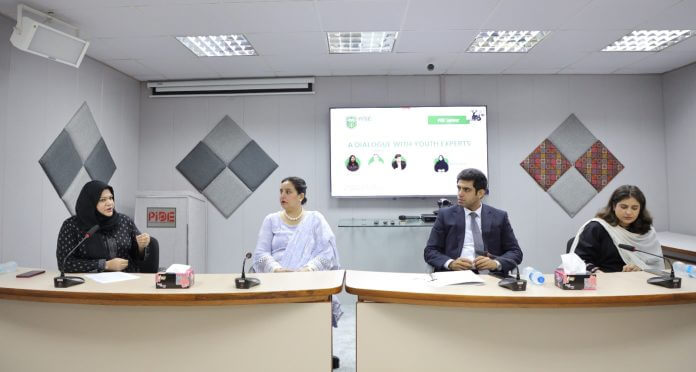
ISLAMABAD: The Pakistan Institute of Development Economics (PIDE) on Wednesday organized a seminar titled “Inclusion, Diversity, and Rights: A Dialogue with Youth Experts” that brought together leading voices from the government and civil society to explore how Pakistan could address the urgent challenges confronting its youth.
Moderated by PIDE Assistant Professor Dr Fizzah Khalid Butt, the discussion featured three distinguished panelists, including Executive Director of Forum for Dignity Initiatives Uzma Yaqoob, Special Assistant to the Minister for Planning, Development and Special Initiatives Ahmed Sultan Butt and Huma Jehangir from Program Implementation Lead, Pakistan Youth Change Advocates.


Uzma Yaqoob addressed the complexities of youth marginalization in Pakistan.
While the often-cited statistic that 65 percent of Pakistan’s population is under the age of 30 is viewed as a demographic advantage, she argued that this potential remains largely untapped due to systemic issues such as poverty, regional inequality, lack of mental health support, and discriminatory social structures.
Representing the government’s perspective, Ahmed Sultan Butt detailed the official vision for youth development under the “URAAN’ Pakistan” initiative, which outlines a strategic roadmap through 2029.
This vision focuses on five key pillars: transitioning to an export-led economy, promoting clean energy, embracing the digital revolution, building resilience to climate change, and fostering ethics and equity.
Ahmed Khalid Butt highlighted government programs such as the Young Peace and Development Corps, which aims to engage one million youth in civic dialogue and skill-building through university-based chapters.
He also discussed large-scale investments in Centers of Excellence in fields like cyber security, artificial intelligence, and industrial automation. These initiatives, he said, are designed to make youth employment-ready while also shifting the state’s approach from job patronage to empowerment and service delivery.
Huma Jehangir addressed the dire state of youth health in Pakistan, especially the rising incidence of non-communicable diseases (NCDs) such as diabetes. Alarmingly, over 33 million people in Pakistan suffer from diabetes, with a significant portion under the age of 30. Despite some government interventions like health cards and cardiovascular centers, the mental health crisis remains neglected.
She pointed out that educational institutions lack even basic counseling units, while community-level support systems are nonexistent.
Huma emphasized the urgent need to recognize mental health as a public health crisis and to treat equity—not equality—as the central principle of policy design.
Throughout the seminar, panelists stressed that real inclusion must be structural, not symbolic. Inclusion cannot be limited to urban, educated, able-bodied youth; it must encompass students, domestic workers, child laborers, and marginalized communities.
Uzma Yaqoob passionately advocated for the political participation of transgender individuals, including dedicated seats in provincial and national assemblies.
She challenged the audience and policymakers alike to question whether institutions are truly ready to be inclusive—not just in rhetoric, but in infrastructure, faculty training, and policy execution.
The panel also discussed the role of NGOs and civil society organizations as vital actors in youth engagement, particularly given their access to grassroots communities.
All panelists agreed that while numerous youth-focused initiatives exist, their effectiveness depends on implementation, monitoring, and alignment with ground realities.
They called for policy design that is participatory, inclusive, and grounded in equity.
In the closing remarks, Dr Fizzah Khalid Butt highlighted that Pakistan’s youth represented immense potential, but without responsive policies and inclusive practices, this demographic dividend could turn into a liability.
The seminar was a call to action for academia, policymakers, and civil society to co-create an environment where all young people—regardless of gender, ability, region, or economic status—can thrive and contribute meaningfully to national development.